DTS validation is the acceptance step that proves rebuilt data is good enough for AI: it checks that synthetic data preserves the statistical structure a model needs to learn while holding a measured privacy guarantee, before that data is trusted for training or evaluation.
Teams rebuild restricted data, then use it on faith. That is the gap DTS validation closes. Even a formal guarantee needs its own inspection: NIST wrote SP 800-226 to guide the evaluation of differential privacy guarantees, and the document catalogs the recurring implementation mistakes it calls privacy hazards. If you cannot state, in numbers, why the synthetic data is trustworthy, you have not finished the transformation. You have only started it.
What DTS validation actually measures
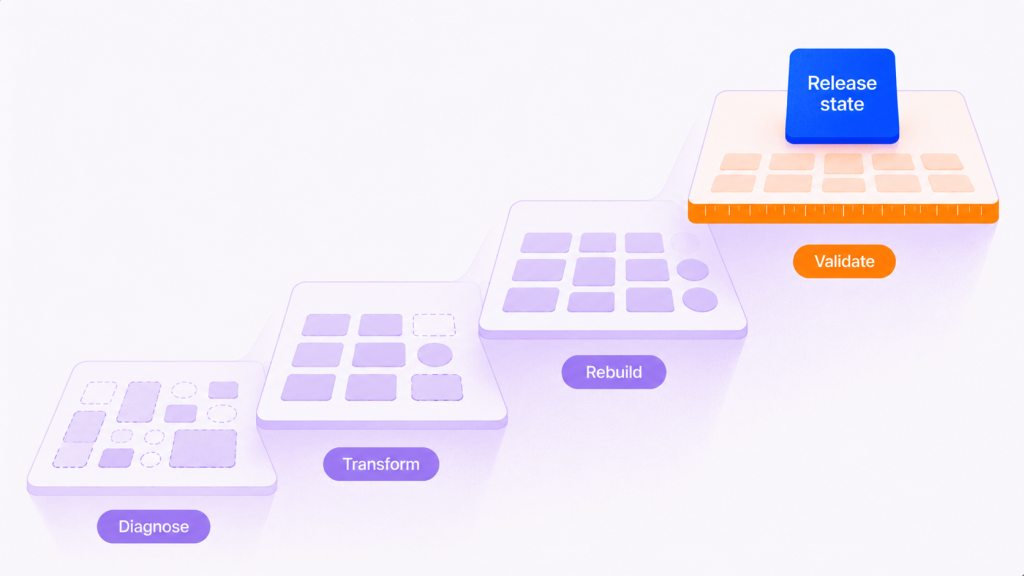
DTS is CUBIG’s AI-ready data transformation engine. It runs a three-move loop, Diagnose, Transform, Rebuild, to turn restricted, scarce, or unusable data into data a model can learn on, using a non-access architecture and structure-preserving synthesis. Validation is the check that sits after Rebuild and before release.
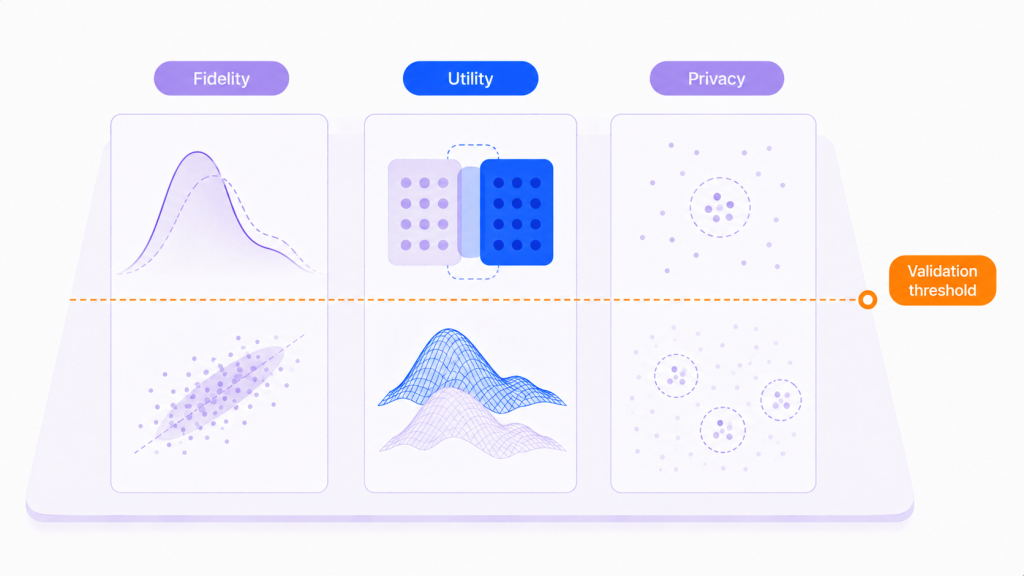
Good enough is not one number. It is an answer to two questions that pull against each other. Does the rebuilt data carry the patterns a model needs, and does it keep the privacy guarantee that let you use the original in the first place? Push fidelity too hard and you leak; push privacy too hard and the data goes flat. DTS validation reports both sides so the tradeoff is a decision you make on evidence, not a hope you hold.
In practice we group the checks into four families: statistical fidelity, whether the shape of the data holds; utility, whether a model trained on synthetic performs when tested on real; privacy, whether an attacker can recover a real record; and coverage, whether the rare but important patterns survive. A dataset that clears one family and fails another is not validated. It is a warning.
The four families of checks, in plain terms
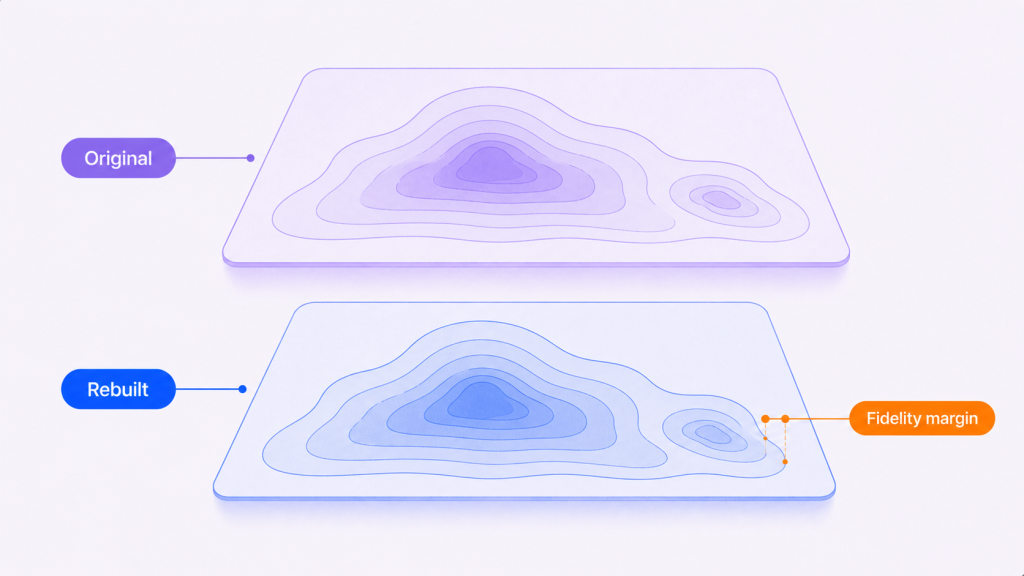
Statistical fidelity compares the rebuilt data against the original distribution: per-column marginals, pairwise correlations, and the joint structure that generic tools tend to smear. For DTS the bar is higher than “the averages match,” because structure-preserving synthesis exists to keep the relationships between fields, not just each field on its own.
Utility is the test that matters to the people who will actually ship a model. Train on synthetic, test on real, and see whether the score lands close to a model trained on the real data. This is often called TSTR, train-on-synthetic test-on-real, and it is the most honest signal that the rebuilt data is fit for its job.
Privacy asks the adversary’s question. Run membership-inference and nearest-neighbor distance checks to confirm that no synthetic record is a thin disguise for a real one. When DTS applies differential privacy during transformation, the privacy budget gives you a stated, auditable bound rather than a vibe.
Coverage asks whether the rare but important patterns survived the rebuild. Fraud, rare defects, and unusual clinical cohorts are exactly the cases a model most needs, and they are the first to vanish when a generator smooths the distribution. DTS treats rare-pattern augmentation as part of the rebuild, so validation confirms those minority classes and edge cases are still present rather than assuming they are.
How the validation metrics compare
The table below lays out the check families, what each one answers, and the failure it catches. Read it as a checklist, not a menu: a release should clear all of them, at thresholds you set before you look at the results.
Why one good number is a trap
A high fidelity score with no privacy check is the classic failure. The rebuilt data matches the original so closely that some rows are near-copies, which means an attacker who holds one real record can confirm it sits in your training set. The opposite trap is just as common: a clean privacy budget on data so noised that a model learns nothing useful, and the utility test quietly tanks.
Coverage is the quiet third failure. Fraud, rare defects, and unusual clinical cohorts are exactly the patterns a model most needs, and they are the first to vanish when a generator smooths the distribution. The UK FCA’s Synthetic Data Expert Group report walks through the financial-services uses that lean on those very patterns: fraud controls, model testing and validation, and data sharing. DTS treats rare-pattern augmentation as part of the rebuild, so validation checks that those patterns survived rather than assuming they did.
Run this self-diagnostic before you trust rebuilt data
If you are about to hand synthetic data to a training team, walk this list first. Any “no” is a reason to hold the release.
- Did you set fidelity, utility, and privacy thresholds before generating, not after seeing the scores?
- Do you have a TSTR result, trained on synthetic and tested on a held-out real set?
- Is there a stated privacy bound, for example a differential-privacy budget, tied to this specific dataset?
- Did you run a membership-inference or nearest-neighbor check for leaked records?
- Did you confirm the rare classes and edge cases you care about are still represented?
- Can you reproduce every one of these numbers from the same inputs on demand?
Where DTS validation fits in an AI-ready pipeline
Validation is not a certificate you file and forget. It is the moment where rebuilt data either earns a place in production or gets sent back. For production AI the real question is not only which model ran but which data state and execution conditions produced the result. DTS runs on the Syntitan platform, CUBIG’s AI-Ready Data Platform, which scores enterprise data on six axes, rebuilds what blocks execution, and binds every AI or agent run to a data state you can diff and reproduce.
That binding is what turns a validation report from a one-time score into something durable. When a regulator or an internal reviewer asks why a model made a decision, you can point to the exact rebuilt data state, its validation numbers, and the run that used it. Science already knows what happens without that discipline: in Nature’s survey of 1,576 researchers, more than 70% reported trying and failing to reproduce a peer’s experiment. A validated, reproducible data state is how DTS keeps its own evidence out of that category, at the data layer rather than after the fact.
If you want the deeper mechanics, see how structure-preserving synthesis keeps field relationships intact, read the Transform step in depth, or start from the pillar, what DTS is.
Try it on your data for free. Run a sample proof and see it on your own workflow.