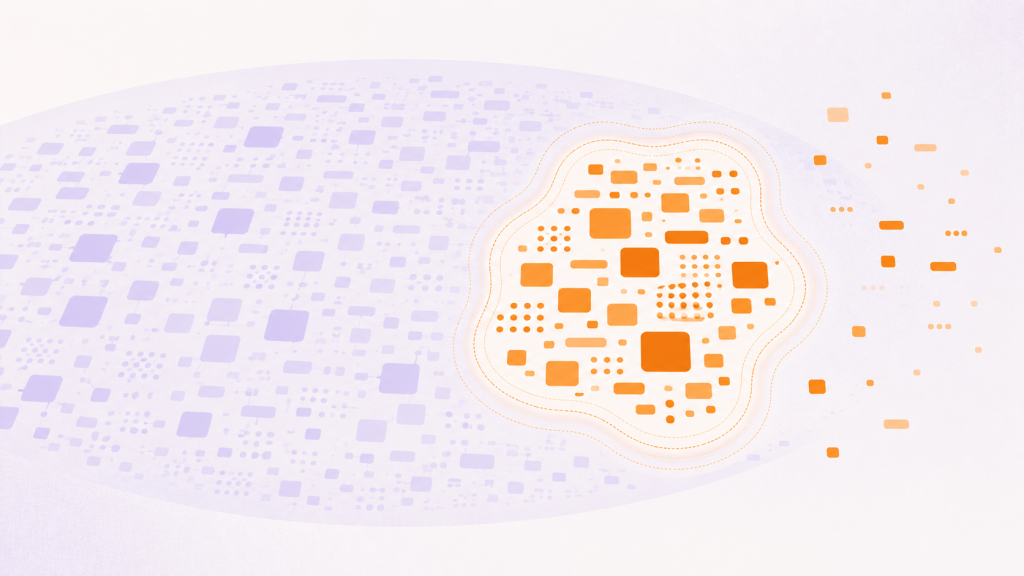
Synthetic patient data for clinical research is data rebuilt to preserve the statistical structure of a real patient population, including its rare cohorts, so a model can learn on it when the original records are too restricted, too scarce, or too imbalanced to use directly.
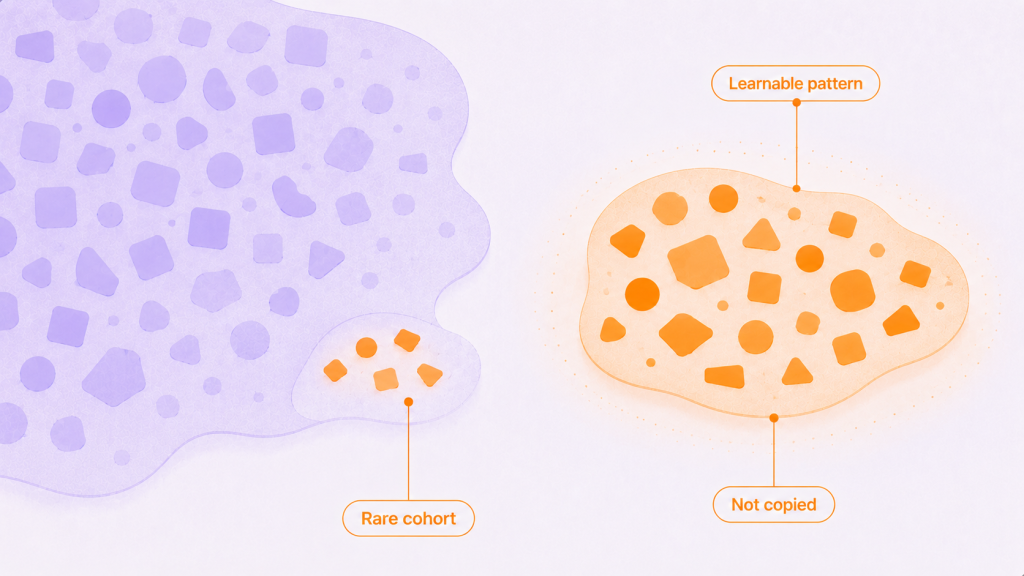
The hard part of clinical research is rarely the common case. It is the rare cohort: the patients with an uncommon comorbidity, the responders who react badly to a standard therapy, the subgroup that shows up a few dozen times across a decade of records. Those cases carry the clinical signal that matters, and they are exactly the cases a model sees too rarely to learn.
They are also among the most closely guarded records an institution holds, which is why an npj Digital Medicine paper argues for patient-centric synthetic data generation in biomedical work: it takes the re-identification risk of analyzing real patient records off the table.
Why clinical research runs short on the cases that matter
Three constraints tend to collide in a research dataset. Access is limited because the records are protected health information governed by HIPAA and institutional review; a modeler often cannot see raw values at all. The sanctioned routes are narrow, too: HIPAA recognizes exactly two de-identification paths, Expert Determination and Safe Harbor, with Safe Harbor requiring the removal of 18 specified identifiers and no actual knowledge that whatever remains could re-identify a patient. Volume is limited because a rare condition may appear in a fraction of a percent of patients, so even a large cohort yields too few positive examples to train on. And balance is skewed, because the healthy majority swamps the clinically interesting minority.
You can wait for more data, but rare cases do not accumulate on a schedule. You can oversample the minority, but naive duplication teaches a model to memorize a handful of patients rather than learn the underlying pattern. Neither path gives a research team a dataset it can actually model, and both leave the rarest, most valuable cohorts underrepresented right when a study depends on them.
What DTS does with clinical data
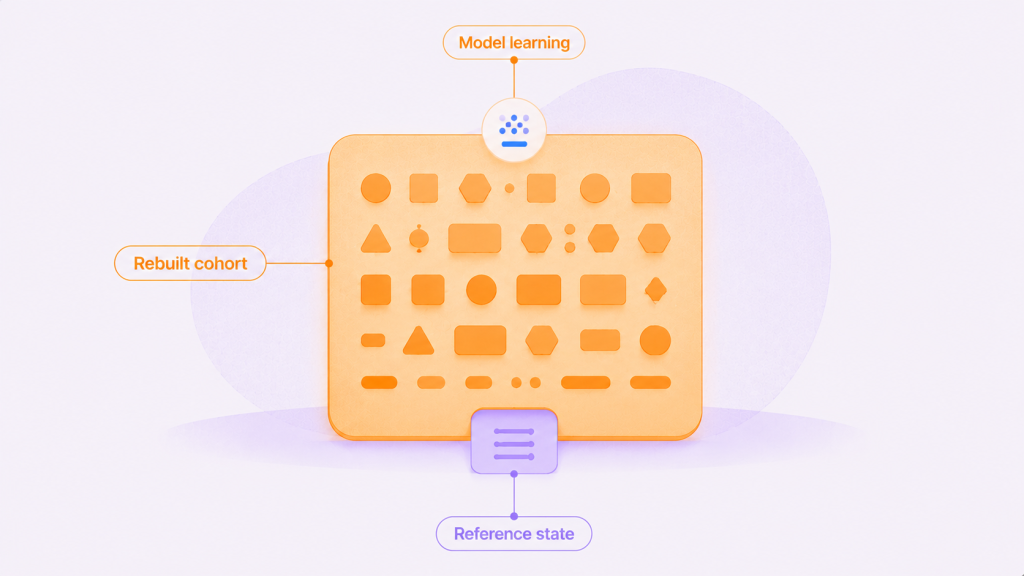
DTS, CUBIG’s AI-ready data transformation engine, works in three steps: Diagnose, Transform, and Rebuild. It diagnoses where a dataset blocks modeling, then rebuilds the blocked parts into data a model can learn on, using structure-preserving synthesis rather than masking or simple copying. DTS runs on the Syntitan platform, so the rebuilt dataset carries a data state a research team can reference later.
Diagnose. DTS profiles the cohort and finds the constraints: which fields are too sparse, which subgroups are underrepresented, where class imbalance will bias a model, and which correlations between variables have to survive for the data to stay clinically meaningful.
Transform. Using a non-access architecture, DTS learns the joint distribution of the population without a modeler ever handling raw identifiers. Differential privacy bounds how much any single patient can influence the result, which matters when a cohort is small enough that one record could otherwise stand out.
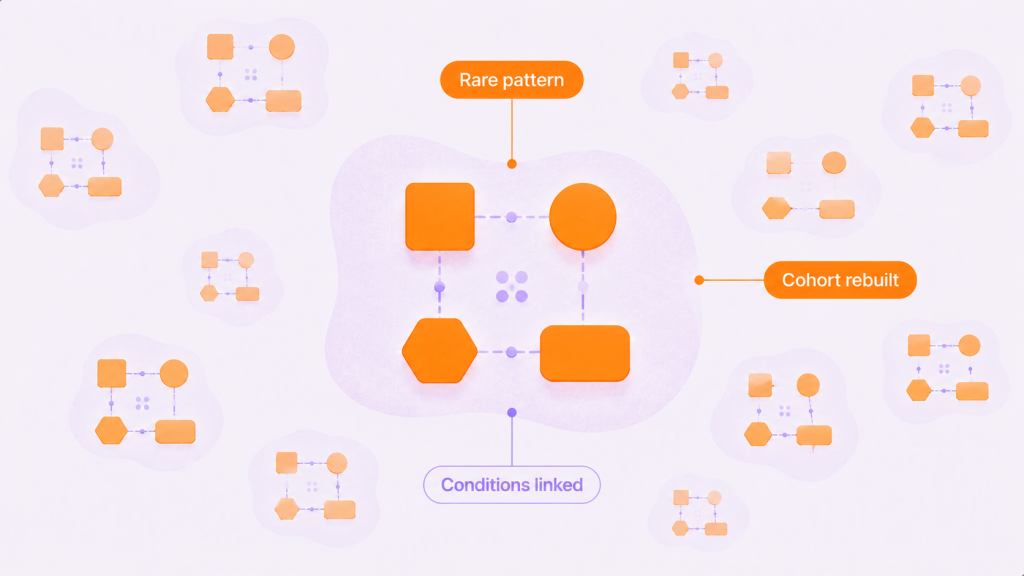
Rebuild. DTS generates records that keep the statistical structure of the original, including the correlations between age, lab values, comorbidities, and outcomes, and it augments the rare cohorts so the minority pattern is represented well enough to learn. This is rare-pattern augmentation: not copying the few real rare patients, but reconstructing the shape of the rare pattern so a model generalizes from it.
Synthetic patient data versus plain masking
It helps to separate structure-preserving synthesis from the older tools it is often confused with. Plain masking hides values but leaves the same thin, imbalanced dataset behind, so the rare-cohort problem is untouched. Anonymization removes identifiers and, in doing so, frequently damages the correlations a clinical model depends on. Structure-preserving synthesis takes a different route: it rebuilds the population so the structure holds and the rare cases are learnable, without exposing any real patient.
| Approach | Rare cohort learnable? | Correlations preserved? | Raw PHI exposed? |
|---|---|---|---|
| Plain masking | No | Partial | Partial |
| Anonymization | No | No | No |
| Naive oversampling | Partial | Partial | Yes |
| Structure-preserving synthesis | Yes | Yes | No |
The distinction is practical, not academic. A masked dataset still fails a rare-disease model for the same reason the raw one did: there are not enough positive examples. A rebuilt dataset changes that, because the rare pattern is represented at a density a model can actually learn from.
A worked example: augmenting a rare responder cohort
Consider a study of an adverse drug response that shows up in roughly one patient in a thousand. A hospital has ten years of records and perhaps forty confirmed cases, spread across different ages, baseline conditions, and dosages. Forty examples will not train a reliable classifier, and the forty are protected, so they cannot leave the hospital’s environment.
DTS diagnoses the cohort in place, learns the joint distribution that links the baseline factors to the response, and rebuilds a larger synthetic cohort in which the responder pattern appears often enough to model, with the age and dosage correlations intact. The research team trains on the rebuilt data, then validates against the real forty cases held back for the test. Results are representative until the team reproduces them on its own held-out data, which is the standard any clinical claim should meet before it moves forward. Here, synthetic patient data does not invent a signal—it rebuilds the distribution the rare responders already imply, at a volume a model can learn from.
How to tell if your cohort needs rebuilding
Run this quick check against a study that is stalling:
- Your target condition or outcome appears in under a few percent of the cohort, and the model keeps predicting the majority class.
- You cannot get raw record access cleared for modeling within the study’s timeline.
- Oversampling or class weights improved training metrics but the model failed on new patients.
- The rare subgroups you care most about have too few examples to split into train and test.
- An anonymized extract broke the correlations your clinicians said were essential.
- You need to explain later how the training data for a result was produced.
If three or more of these are true, the blocker is the data, not the model, and rebuilding the cohort is the step that unblocks the study. When those signs line up, synthetic patient data is usually the fastest route to a dataset a model can actually train on.
Where it fits in AI-ready clinical work
DTS handles one specific job: turning restricted, scarce, or imbalanced clinical data into data a model can learn on. Because it runs on the Syntitan platform, the rebuilt dataset is not a loose file with no history. The platform records the data state behind each rebuild, so a team can reference which version of the data trained a given model and reproduce that state later, which is what auditors and review boards tend to ask about first. The regulatory trajectory points the same way: the FDA approaches AI in software as a medical device with oversight spanning the total product lifecycle, grounded in Good Machine Learning Practice guiding principles. For teams weighing rebuilding against protection-only tools, our comparison of PHI masking versus synthetic data lays out where each one fits, and what DTS is covers the engine end to end. The related question of reproducing a clinical result is covered in reproducible cohort analysis. That is what makes synthetic patient data usable for a model, not just safe to store.
Try it on your data for free. Run a sample proof and see it on your own workflow.