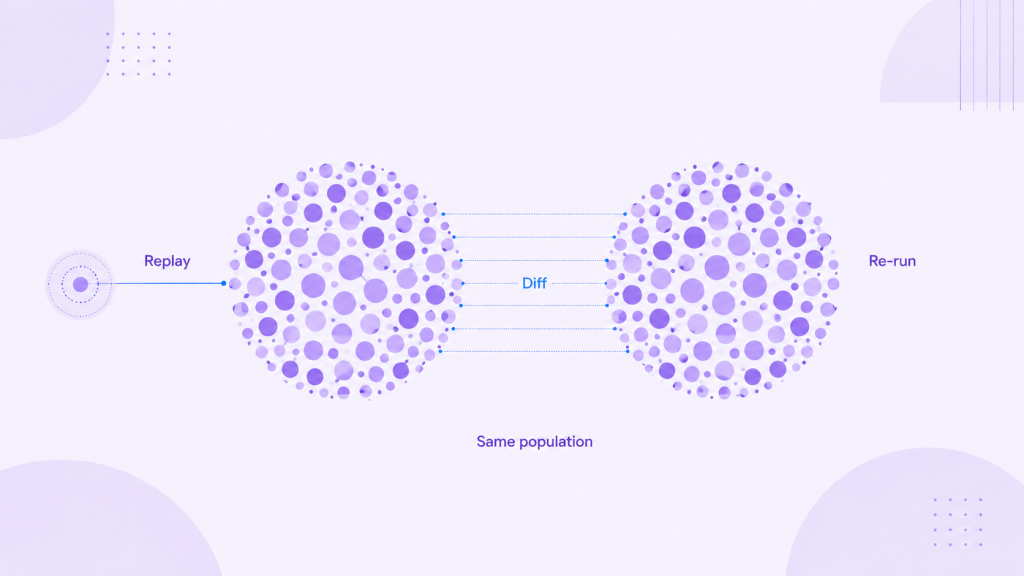
Reproducible cohort analysis means any patient population you define for research or clinical work can be recreated later from a recorded data state, so the same definition returns the same group and a second review starts from the same population.
The stakes are concrete. The FDA’s approach to AI in software as a medical device is total-product-lifecycle oversight, backed by Good Machine Learning Practice guiding principles, and oversight across a lifecycle assumes results that can be revisited. In a hospital or a research group, that expectation shows up as a specific failure mode: a cohort that cannot be recreated, and a result no reviewer can stand behind.
What reproducible cohort analysis actually requires
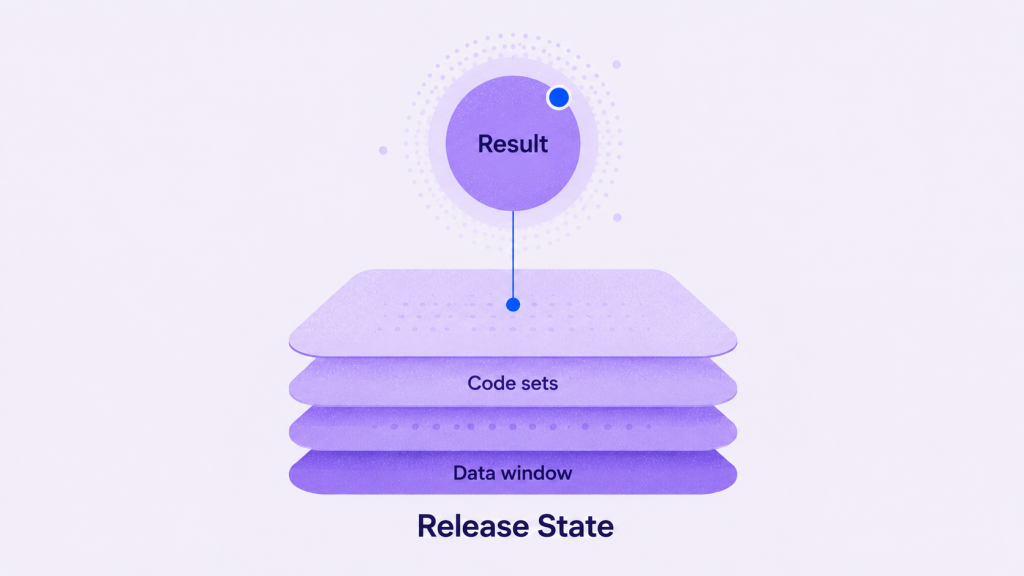
A cohort is not just a query. It sits on top of a stack of moving parts: diagnosis and procedure code sets, terminology mappings, eligibility rules, a data window, and the reference tables that resolve all of them. When a team reports a finding, that finding belongs to one specific combination of those inputs at one moment in time.
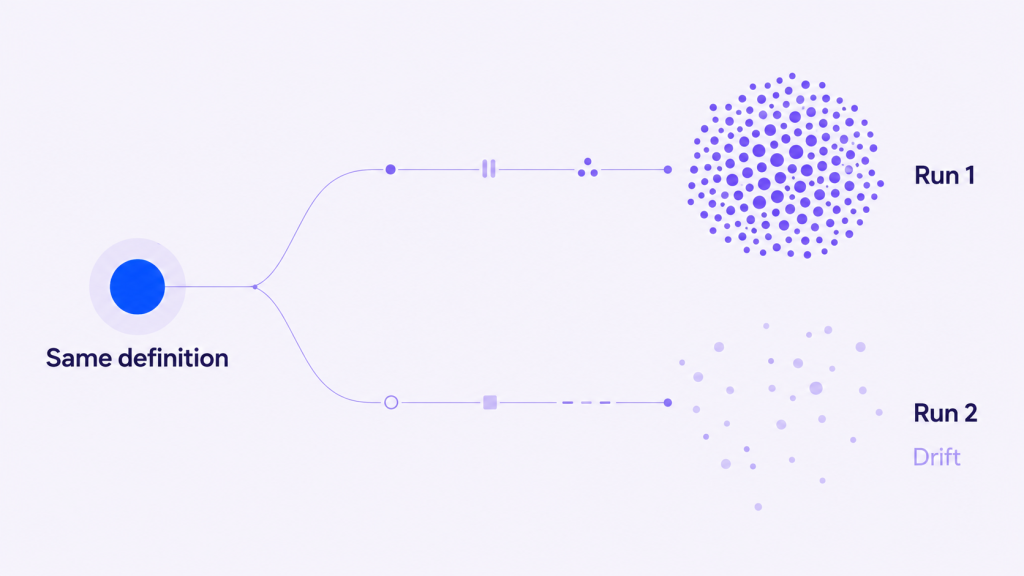
The problem is that the query text stays the same while the stack underneath it shifts. A code set gets updated to a new revision. An inclusion criterion is refined after a chart review. A mapping table absorbs a correction. Nobody edits the SQL, yet the population it returns next quarter is a different group of people. This is the same quiet failure we describe in the hidden cost of stale reference data: nothing errors, so nothing warns you.
Reproducibility, then, is not a property of the code. It is a property of the whole data state that produced the result. To make cohort analysis reproducible you have to capture that state and be able to return to it on demand.
Where cohort analysis breaks in practice
Consider a research team studying outcomes for patients with a chronic condition. They define the cohort by a set of diagnosis codes, an age range, and a two-year lookback on encounters. They run the analysis, publish an internal finding, and move on.
Six months later a regulator, an internal review board, or a journal reviewer asks them to reproduce the result. The team reruns the “same” cohort and the N is off by several hundred patients. The lookback window was recalculated against a refreshed encounter table; two of the diagnosis codes were remapped when the terminology set was updated; one eligibility rule was tightened. Each change was reasonable on its own, but together they mean the original cohort no longer exists anywhere, and neither does the ability to explain the finding it supported.
This is not a privacy incident and it is not a modeling error. It is a data-state problem, and it is why so much clinical and research AI work becomes hard to defend the moment someone asks a second time. The wider research world knows the feeling: failed attempts to reproduce another scientist’s experiment are a long-running concern in research.
How a bound data state makes cohort analysis reproducible
The fix is to tie each cohort analysis to a recorded Version of the data: a captured version of the cohort definition, the code sets, the mappings, and the data window that produced a given result. Three things follow from that link.
Link the result to its data. A specific result points to the data used at the time, so the cohort behind a finding is an address you can return to, not a description you have to piece together from memory. Compare with the previous state. A comparison shows why a re-run returns a different population: it names the updated code set or the shifted criterion instead of leaving the team to guess. Return to the earlier Version. A reviewer can inspect the cohort as it stood when the finding was made. You can read more about the comparison mechanics in how comparing data states works.
Crucially, none of this requires moving raw patient records. The system records the state and the conditions of execution, so reproducibility and patient-data handling stay separate concerns rather than trading off against each other. The handling side is tightly specified: HIPAA recognizes exactly two de-identification paths, Expert Determination and Safe Harbor, which removes 18 specified identifiers. Recreating a cohort is a different problem, and neither path solves it. Teams that run analytics directly on protected health information can pair this with the patterns in healthcare workflows on PHI.
What changes when a cohort is bound versus not
The point of the table is not that reproducibility guarantees identical downstream statistics. It is that the cohort stops being a moving target. The numbers still belong to the analysis; what changes is that the conditions behind them are recoverable, so a result is representative until you reproduce it on your own data and confirm it.
A quick self-diagnostic for your cohort work
Run this test against a cohort your team reported in the last year. If you cannot answer yes to most of these, your cohort work is not yet reproducible:
- Can you point to the exact code sets and terminology mappings that were in effect when the cohort was defined?
- If you rerun the definition today, can you explain every difference in the resulting N?
- Can a reviewer inspect the original population without you recreating it by hand?
- Is the data window pinned to a recorded state, not to “whatever the table holds now”?
- Can you produce all of the above without exporting raw patient records?
Where it fits in CUBIG’s operating layer
For production AI, the question is not only which model ran; it is which data state and execution conditions produced the result. Syntitan, CUBIG’s AI-ready data platform, prepares and checks enterprise data for a specific AI task. It diagnoses data on six axes, Usability, Integrity, Context, Consistency, Reproducibility, and Traceability, and creates a new data Version after each successful processing run, so you can see the data used at the time and compare it with the previous state. For a cohort, that means the data behind a result can be kept as a Version rather than living in someone’s memory. Tracking changes after release and linking runs to that data are planned for December. To see how this connects to the broader category, start with what AI-ready data means and how a run is linked to its data.
The healthcare payoff is direct: a reviewer can say “show me this exact cohort as it was defined then” and get an answer instead of an apology. Reproducible cohort analysis turns a fragile finding into one your team can defend twice.
Try it on your data for free. Run a sample proof and see it on your own workflow.