A bank’s AI team wants an LLM to summarize customer complaint letters. The vendor questionnaire is complete, yet the compliance lead still asks which customer details will leave the bank.
An AI vendor risk assessment is the review a company runs before an AI provider processes its data or supports its work, covering the vendor’s controls, the data the vendor will receive for each use case and the obligations attached to that data, so the company can decide whether to go ahead.
In CUBIG’s view, a questionnaire describes the vendor, and the approval decision also depends on the data each task sends. CUBIG defines AI-ready data as data prepared for a specific AI task, with results checked, that can be used within permission, regulatory and contract limits. For an AI vendor review, that means the team decides which information the task needs and which information it can leave out.
Key takeaways
- A vendor questionnaire describes the vendor; approval also depends on what data each task sends.
- Prompts, retrieved documents and attachments can carry sensitive values that a questionnaire about the vendor does not show.
- The compliance team can review each task: the fields it needs, the values it can leave out and who approved it.
- An assessment records decisions about which data goes where; the team reviews it again when the task, the data or the vendor changes, including when the vendor changes its underlying model.
What does an AI vendor risk assessment cover?
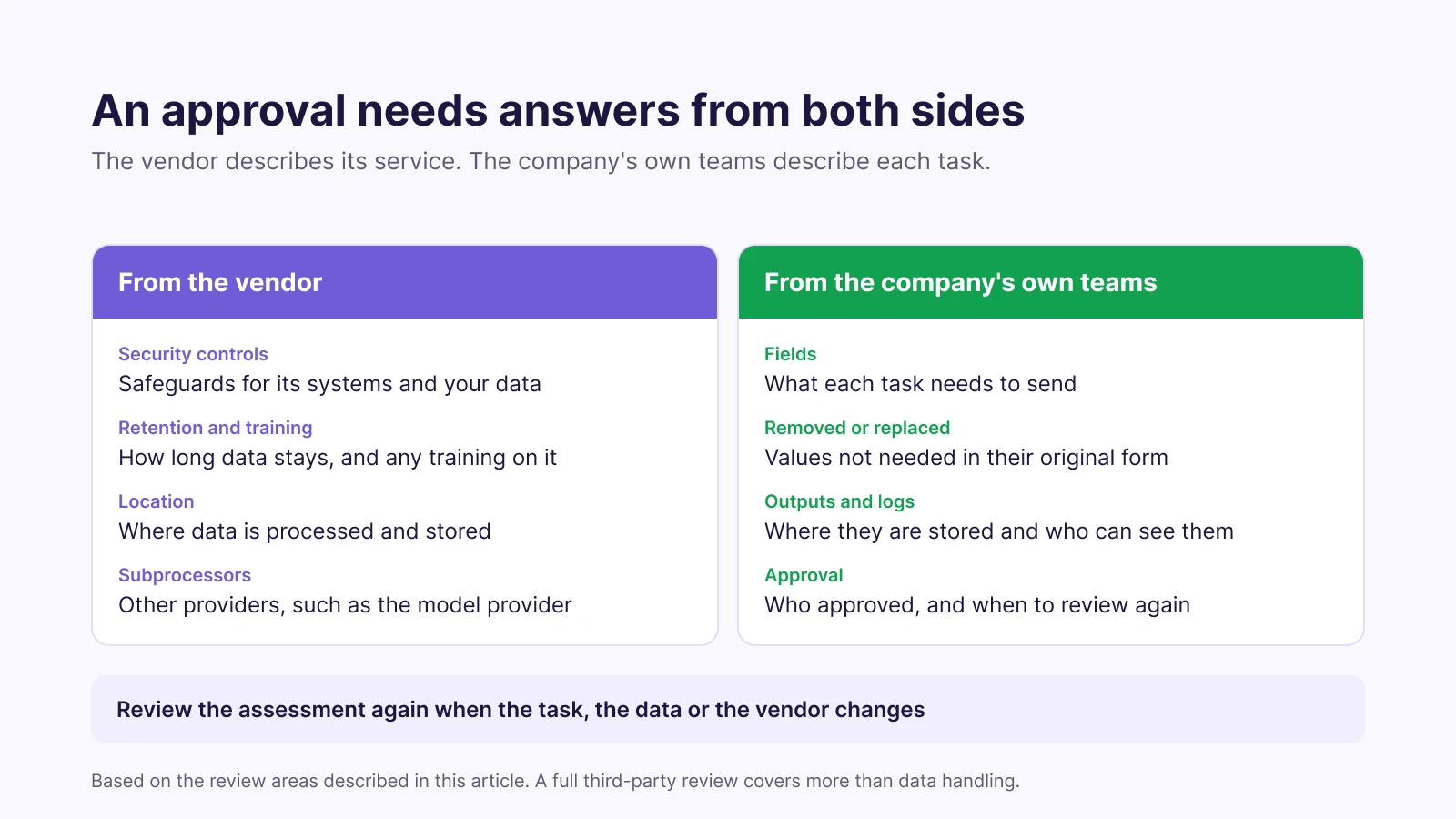
An AI vendor risk assessment examines how the vendor handles data and how the company plans to use the service. The table below covers data handling only; a full third-party review covers more areas, and banking guidance spans the relationship from planning to termination. The reviewer needs answers from the vendor and from the company’s own teams, because the vendor’s controls do not say what a particular AI task will send.
| Area | What the reviewer asks | Where the answer comes from |
|---|---|---|
| Security controls | What safeguards protect the systems and data the vendor handles? | The vendor (questionnaire, security documentation) |
| Data retention and model training | How long does the vendor keep data, and does the vendor use it to train models? | The vendor (questionnaire, contract terms) |
| Data location | Where does the vendor process and store the data? | The vendor (questionnaire, contract terms) |
| Access and subprocessors | Who can access the data, and which other providers handle it, including the provider of the underlying model? | The vendor (questionnaire, contract terms), reviewed by procurement |
| Data each task sends | Which fields and values does this AI task need? | The company’s AI team and data owner |
| Outputs and logs | What appears in outputs and logs, where is it stored and who can see it? | The company’s AI team, and the vendor for logs the vendor keeps |
Why do LLM approvals stall after the questionnaire is done?
The OWASP GenAI Security Project lists sensitive information disclosure in its 2025 Top 10 for LLM Applications and states: “Sensitive information can affect both the LLM and its application context.” Prompts, retrieved documents and attachments can carry sensitive values that a questionnaire about the vendor does not show.
In the complaint-letter example, the AI team could send customer names, account numbers and complaint histories when the summary needs only part of that information. OWASP lists data sanitization, which keeps user data out of model training, as one mitigation. The questionnaire asks whether the vendor trains on submitted data, so it answers the training question from the vendor’s side. The compliance lead still has to look at the specific task, its inputs and where its outputs go before deciding whether to proceed.
What should the compliance team ask about the data each task sends?
The compliance team can document the data flow for each AI task before the vendor processes any of it:
- Identify which fields the task needs to produce its result.
- Flag which values are sensitive or controlled under company policy, contracts or applicable rules.
- Note the original collection purpose, and ask the privacy or legal team whether the new use is compatible with it (purpose limitation, where GDPR applies).
- Remove values the task does not need, and replace values whose meaning the task needs but whose actual value it does not.
- Record where outputs and logs are stored and who can see them.
- Document who approved the use and when the team must review it again.
- 01Name the task
The AI team states what the model does, such as summarizing complaint letters.
- 02List what it sends
The data owner lists the fields, documents and attachments the task would send.
- 03Remove or replace
The team leaves out values the task does not need and replaces values it needs only for context.
- 04Record and review
The compliance lead records who approved the use and when to review it again.
GDPR Article 5(1)(b) says personal data shall be “collected for specified, explicit and legitimate purposes and not further processed in a manner that is incompatible with those purposes”. The privacy or legal team decides whether a new AI use is compatible; this article is not legal advice.
Where does an AI vendor review fit in existing risk guidance?
The Board of Governors of the Federal Reserve System, the FDIC and the OCC issued final joint guidance on third-party risk management on June 6, 2023. The guidance “describes principles and considerations for banking organizations’ risk management of third-party relationships”. The guidance covers each stage of a third-party relationship: planning, due diligence and third-party selection, contract negotiation, ongoing monitoring, and termination. The release does not mention AI. A bank can still treat an AI provider as a third party, run the data questions above during due diligence and repeat them during ongoing monitoring when a task changes.
NIST published the Artificial Intelligence Risk Management Framework: Generative Artificial Intelligence Profile (NIST AI 600-1) on July 26, 2024, as a cross-sectoral companion resource to its AI Risk Management Framework for generative AI. NIST says the AI RMF is intended for voluntary use; a team can draw on the profile when it writes its own review questions.
How can a team send less sensitive data without breaking the task?
The AI team can send only the fields the task needs. When the task needs the meaning of a value rather than the value itself, the team can replace the value with a substitute that keeps the context. A name stays a name and a date stays a date, so the model still reads each value as the same kind of information.
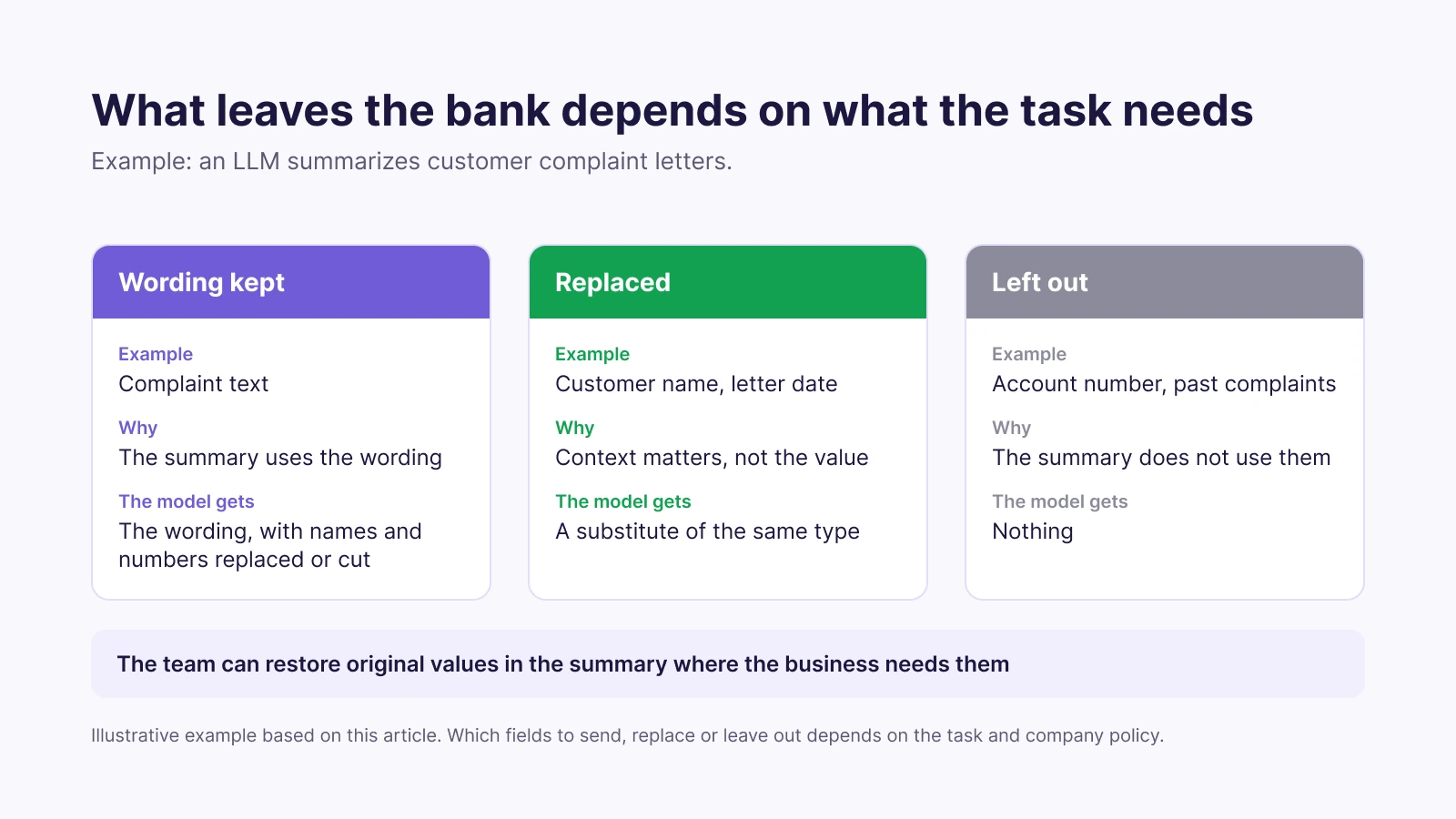
The team can restore original values in the answer where the business needs them. The AI lead tests the task with substituted values and confirms that the result still supports the work. The team records which values it replaced and which values the vendor still receives.
Where does CUBIG fit?
LLM Capsule is CUBIG’s context-preserving data layer for AI. LLM Capsule replaces sensitive or controlled values with context-preserving substitutes before data is sent to an AI service, then restores the original values in the response so the result can be used in the actual work. LLM Capsule can be adopted on its own.
CUBIG Shorts
Where LLM Capsule Sits in Your Workflow
A short clip from CUBIG on The Ravit Show.
LLM Capsule does not assess vendors, approve uses or decide compatibility; the compliance, privacy and legal teams make those calls. Related reading: sensitive data discovery, AI data leakage and AI agent permissions.
An assessment does not make a vendor safe or a use compliant on its own. The assessment records what the company decided about which data goes where and why, and the compliance lead reviews it again when the task, the data or the vendor changes. When a task needs the context of sensitive values rather than the values themselves, see how LLM Capsule fits.