Collibra is one of the strongest names in data governance, and it earns the position. It gives an enterprise a business glossary, data stewardship workflows, lineage for audit, and policy controls over who may touch what. More recently it has extended into AI governance, with a command center that gives an organization visibility and policy over the AI systems running across it. If the job is to understand, organize, and control a data estate, Collibra does that job well. That job has a formal name: DAMA International defines data management as the practices that deliver, control, protect, and enhance the value of data assets across their lifecycle.
In September 2026 Collibra added Agent Contracts, machine-readable rules for what AI agents are expected and permitted to do, with Guardian Agents supervising agents against those rules at runtime. It showed them at its New York AI Summit on October 6. The move brings policy to the moment an agent acts, and it makes the line in this comparison easier to see. A contract states which data an agent may use. Keeping the exact data state a given run used, so the run can be compared or reproduced later, is a separate job, and it has to happen on every run. That is why teams run it as an operating layer next to governance rather than as a one-off review.
Teams sometimes line Collibra up against Syntitan because both now use the language of AI readiness. Put side by side, though, they are answering two different questions, and seeing the difference clearly is more useful than ranking them.
Governance answers can we use this data? Syntitan answers can this AI result be reproduced?
Those are not competing claims on the same territory. They are claims on different layers of the stack. Governance operates over the data estate: the catalog of assets, the rules that apply to them, the lineage of where data came from. A data catalog, in the standard definition, is an inventory of an organization’s data assets that helps people find the data they need. Syntitan operates over a single AI run: it captures and versions the exact data state a model executed on, so that state can be compared against a later one, replayed, and the result reproduced.
Where the line falls
The clearest way to see it is an audit question. Suppose a model produced a decision, and someone asks why. A governance system answers part of that. Collibra can trace governed assets and lineage into AI systems, showing which model, which dataset, and which pipeline were involved, and that policy was followed. That is real, and it matters for the control question. It is a different guarantee from reproduction. Lineage shows the path data took. It is not built to capture, version, replay, and compare the exact data state behind a specific run. Lineage is not reproducibility, and that is the part Syntitan holds.
| Collibra | Syntitan | |
|---|---|---|
| The question | Can we use this data? | Can this AI result be reproduced? |
| Scope | The whole data estate | A single AI run’s data state |
| Lineage is for | Audit and compliance | Reproducing a specific run |
| On a changed result | Shows who accessed which assets | Diffs the data state and re-runs the prior one |
| On AI | Governs AI systems across the org | Binds and reproduces the state behind a run |
| On AI agents | Agent Contracts set what an agent may do; Guardian Agents check it at runtime | Keeps the data state each agent run used, so the run can be compared and reproduced |
When to reach for each
If the problem is that the organization cannot agree on what its data means, who owns it, or whether policy is being followed, that is a governance problem, and Collibra is built for it. If the problem is that a model worked in the proof of concept and drifts once it is live, and nobody can reconstruct the data state that worked, governance will not close that gap on its own. That is the layer Syntitan adds, and it runs alongside a governance program rather than replacing it. A team can govern its estate with Collibra and still have no way to reproduce a given run. The two cover different ground.
What reproduction takes
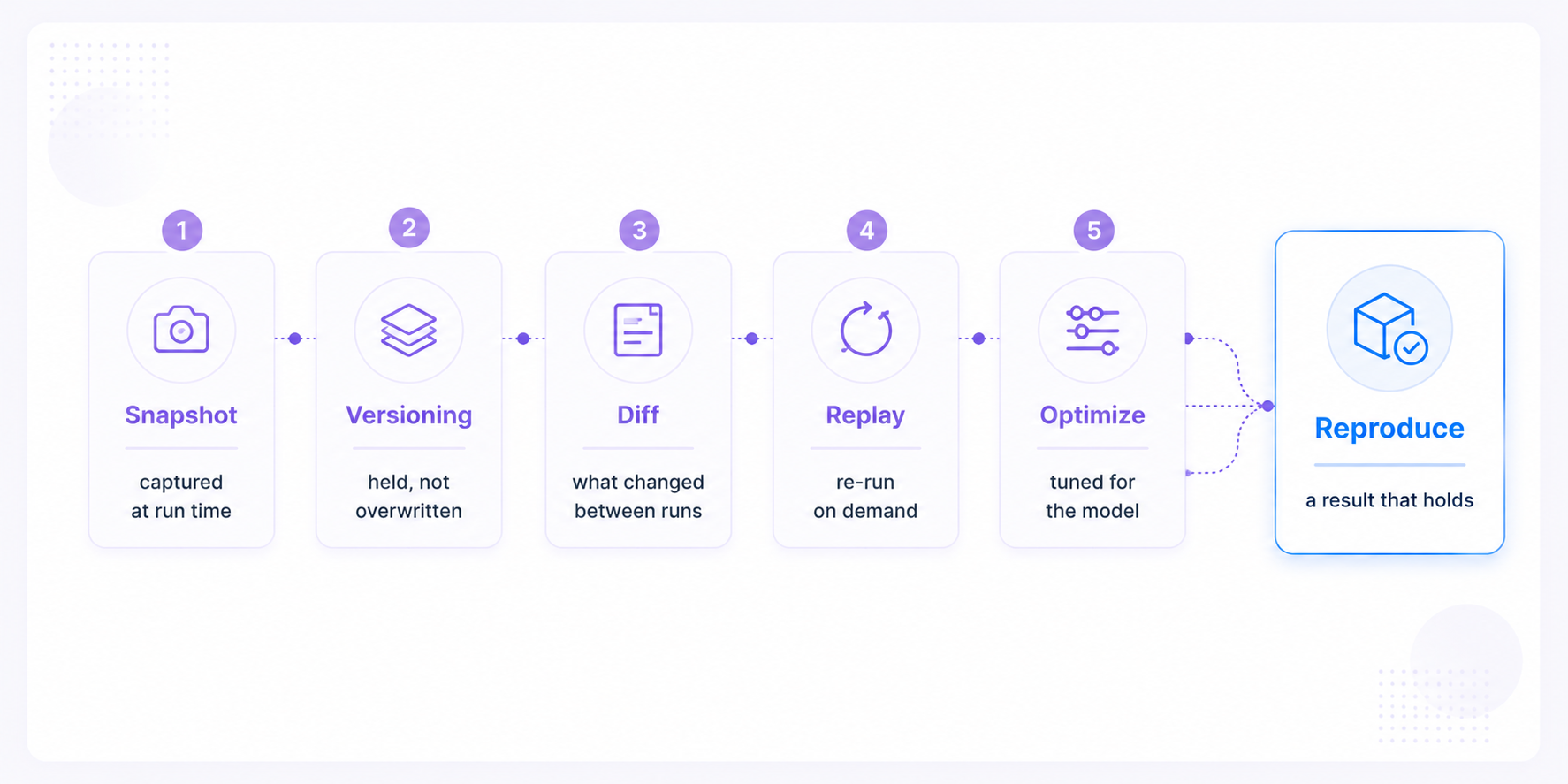
Reproduction is the outcome. It rests on a set of mechanisms that a governance program is not built to provide. Syntitan captures and versions the exact data state behind an AI run, so a team can compare, replay, and reproduce results when conditions change. In practice that means:
- Snapshot. The exact released state of the data a run executed on, captured at the moment it ran.
- Versioning. That state held as a versioned release, not overwritten by the next refresh.
- Diff. A clear comparison of what changed in the data between one run and the next.
- Replay. The earlier state re-run on demand, so the prior result can be reproduced.
- Optimize. The data tuned for the specific model the run uses, then released in that state.
Those are the moving parts behind the one-line difference. A governance suite can tell you a run happened and trace its lineage. These mechanisms are what let you reproduce it.
The shorter version
Collibra makes a data estate understood and controlled, and it is strong at that. Syntitan captures and versions the data state behind an AI run, so the result can be compared, replayed, and reproduced when the data moves. Both are forms of AI readiness, for different questions. Most teams running models in production need their data both governed and reproducible, which is why these sit on top of each other rather than against each other.