Table of Contents
What is Data Ingestion?
Basic Concept and Definition
Data ingestion is the process of gathering data from multiple sources and transferring it into a system where it can be stored, processed, and analyzed. These sources might include databases, cloud storage, IoT devices, or external APIs. The goal is to collect raw data and make it available in a consistent and usable format. Without proper ingestion, valuable data remains scattered and unusable, limiting insights and decision-making.
Why Data Ingestion Matters in Modern Data Systems
In today’s fast-paced world, organizations rely on real-time and historical data to stay competitive. Data ingestion ensures that data flows continuously and reliably into analytics platforms and data warehouses. This ongoing stream allows for timely analysis, machine learning model training, and operational decision support. Without a robust ingestion process, systems face delays, errors, and incomplete data, which can hurt business outcomes.
Why is It Important to Ingest Data?
Ingesting data is essential for keeping information fresh and accurate. It ensures that data from diverse sources—such as social media feeds, transaction logs, and sensor outputs—is consolidated into one place. This consolidation helps data scientists, analysts, and decision-makers access a unified, up-to-date view. Proper ingestion reduces the risk of working with outdated or inconsistent data, enabling better forecasting and strategic planning.
Data Ingestion Pipelines Explained
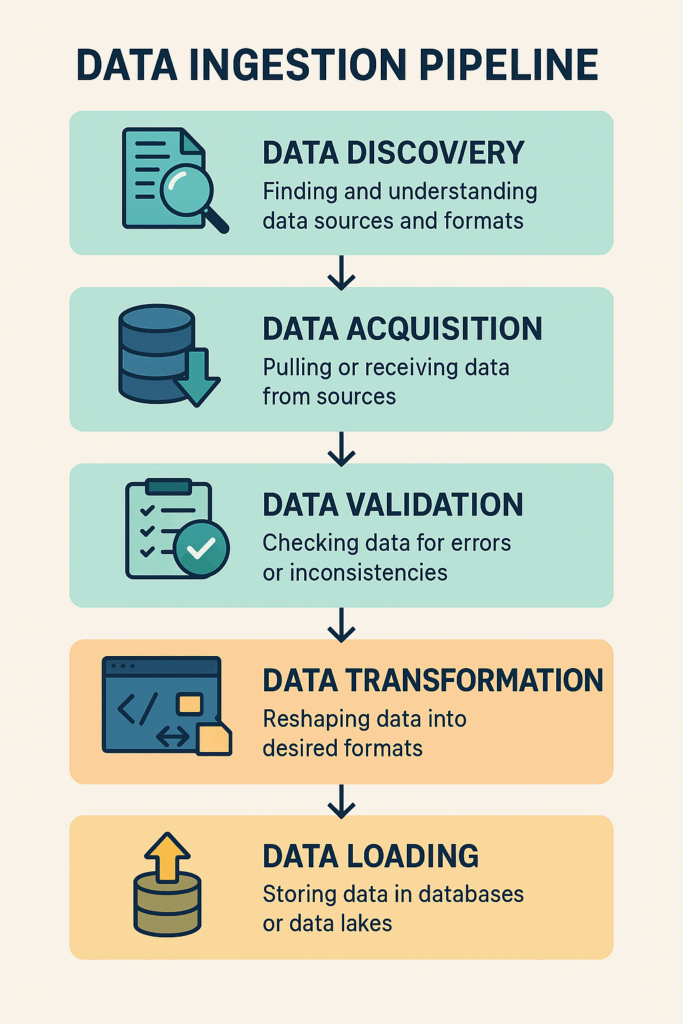
Typical Data Ingestion Pipeline Flow
A data ingestion pipeline is a sequence of steps designed to collect and prepare data for use. Each stage adds value by improving the data’s quality and readiness.
1) Data Discovery
This first step involves finding what data is available, where it lives, and understanding its structure. It’s important to identify relevant data sources and evaluate data formats.
2) Data Acquisition
Once sources are known, data acquisition pulls or receives data. This might involve batch downloads or real-time streaming, depending on the use case.
3) Data Validation
Validation checks for missing data, errors, or inconsistencies. It ensures that only trustworthy data moves forward, reducing downstream problems.
4) Data Transformation
Raw data often needs reshaping—such as converting dates, normalizing values, or combining fields—to fit the target system’s needs.
5) Data Loading
Finally, data is loaded into databases, data lakes, or warehouses, where it becomes available for queries and analytics.
Synthetic Data Workflow and Ingest Pipeline Structure
In synthetic data workflows, ingestion pipelines must also protect sensitive information. Data is not only collected but also processed to generate artificial yet realistic datasets. This often includes privacy-preserving steps and data augmentation to create varied and balanced synthetic data.
Ingested Is Not the Same as AI-Ready
A pipeline that lands data reliably has solved delivery, not readiness. The rows can arrive on time and still be unusable for a model — restricted by policy, inconsistent between loads, or stripped of the context that made them meaningful. CUBIG fills that gap: Syntitan takes what the pipeline delivers and releases a fixed AI-ready data state, with DTS handling the parts that cannot move in their original form.
Industry-Proven Best Practices for Effective Data Ingestion
Cloud Data Lake Ingestion
Cloud data lakes provide scalable storage for large datasets. Best practice involves ingesting raw and processed data into these lakes efficiently, enabling flexible access for analytics and AI.
Cloud Modernization
Modernizing data systems by moving them to the cloud improves scalability, reliability, and cost-effectiveness. It enables faster data ingestion and better integration with cloud analytics services.
Real-Time Analytics
Ingesting data in real time allows organizations to monitor events as they happen. This capability supports rapid decision-making and immediate responses to business needs.
Data Ingestion Tools
| Tools | Summary |
|---|---|
| Open Source Tools | Flexible, cost-effective, strong community |
| Proprietary Tools | Advanced features, enterprise support |
| Cloud-Based Tools | Managed services by AWS, Azure, Google Cloud |
| On-Premises Tools | For data control, security, compliance |
| Hand-Coded Pipelines | Custom, precise control, more development |
| Prebuilt Connector & Transformation Tools | Ready-made modules simplifying ingestion |
| Data Integration Platforms | All-in-one data connection and management |
| DataOps | Automation for CI/CD and pipeline monitoring |
Open Source Tools
Tools like Apache NiFi and Apache Airflow provide flexible, cost-effective ingestion solutions supported by strong communities.
Proprietary Tools
Commercial tools offer advanced features, support, and integrations for enterprise needs.
Cloud-Based Tools
Cloud providers such as AWS, Azure, and Google Cloud supply managed ingestion services that reduce setup time and maintenance.
On-Premises Tools
Some businesses require on-premises solutions for data control, security, or compliance reasons.
Hand-Coded Pipelines
Custom pipelines allow precise control tailored to specific workflows but require more development effort.
Prebuilt Connector and Transformation Tools
These tools simplify common ingestion tasks by providing ready-made modules for popular data sources and transformations.
Data Integration Platforms
All-in-one platforms help connect, transform, and manage data flows from many sources into unified systems.
DataOps
DataOps automates and improves ingestion pipelines, fostering continuous integration, delivery, and monitoring.
Key Challenges in Data Ingestion
Data Security
Protecting data during ingestion is critical, especially when handling sensitive or personal information. Encryption, access controls, and auditing are essential.
Scale and Variety
Ingesting vast amounts of data from diverse sources requires scalable infrastructure and flexible designs to handle different formats and speeds.
Data Fragmentation
Data spread across many systems can cause silos and inconsistencies, complicating ingestion and analysis.
Data Quality Assurance
Maintaining high data quality demands continuous validation, cleaning, and monitoring throughout the ingestion process.
Related reading
- AI-ready data — what has to be true before a model can use your data.
- Syntitan — the platform that releases a data state and binds each AI run to it.
- DTS — how restricted data is rebuilt into a usable version.
- LLM Capsule — running approved models on data that cannot move in its original form.
- Learn Hub — articles and guides on enterprise AI data.