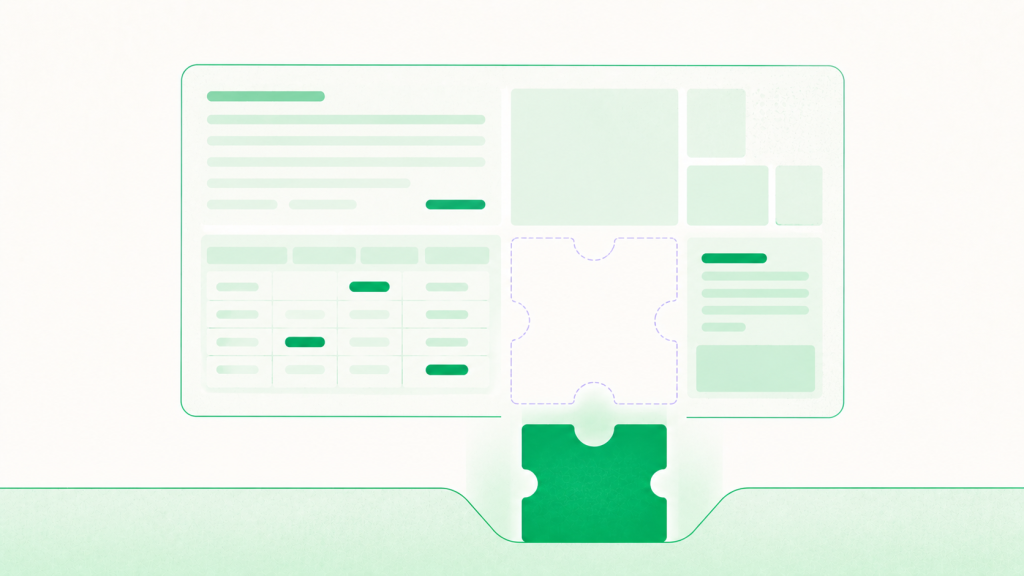
Workflow closure is the point at which an AI step returns a finished business artifact rather than a draft, because its output has been reconstructed back into the original context, which is what turns a model response into work that is actually done rather than work someone still has to reassemble by hand.
Most enterprise AI pilots stop one step short of workflow closure. The model produces something impressive in the demo, and then a person quietly spends twenty minutes putting the answer back into the document it came from. The demo closes the loop; the production workflow does not. Pilots that stall at this step rarely fail on model quality at all. They fail because the last mile, the reassembly, was left to people.
The gap between a response and a result
Consider what actually happens when a confidential document runs through a large language model. To get useful output without exposing the real values, the team substitutes or strips the sensitive parts first, then sends the model the structure of the work rather than the raw values. The model returns its answer against those stand-ins. Now a person has to map the placeholders back to the real entities, drop the text into the right cells, fix the formatting, and confirm nothing slipped.
The model did the thinking; a human did the reassembly. That reassembly is where the value leaks back out, because it is slow, it is easy to get wrong, and it scales badly across hundreds of documents a week. A workflow that needs a person to finish every AI step is not really an AI workflow, it is a manual workflow with a model bolted into the middle. The tidy numbers from the pilot deck rarely survive contact with that reality.
What closing the loop actually means
Closure happens when the output comes back already mapped to the original context. The placeholders resolve to the real values, and the result lands in the structure it belongs to: the same table, the same clause numbering, the same layout the source had. What the reviewer opens is the finished document, not a kit of parts shipped with assembly instructions.
Picture a renewal contract sent out for an obligations summary. An open workflow returns prose that refers to “Counterparty A” and “the agreed figure.” A closed workflow returns the summary with the actual counterparty named and the real amount in place, sitting in the document where legal expects to read it. One is a draft; the other is done, and the difference between them is reconstruction back to the original context.
Why closure depends on the data boundary
Closure and confidentiality turn out to be the same problem solved well. The reason output usually comes back unfinished is that the real values were removed so the model could run at all. Restore those values locally, inside your own environment, and you get two results at once: the workflow closes, and the confidential data never had to cross the boundary during LLM data egress.
This is why a substitution that preserves structure matters far more than one that simply blanks the data out. If the model worked on a coherent copy, with tables intact, relationships intact, and the confidential business context represented faithfully by stand-ins, then reconstruction is a clean mapping back. If the model worked on a redacted mess, there is nothing coherent to reconstruct, and closure stays impossible no matter how strong the model is. Plain masking optimizes for hiding values; enablement optimizes for finishing the work.
Open loop vs closed loop, side by side
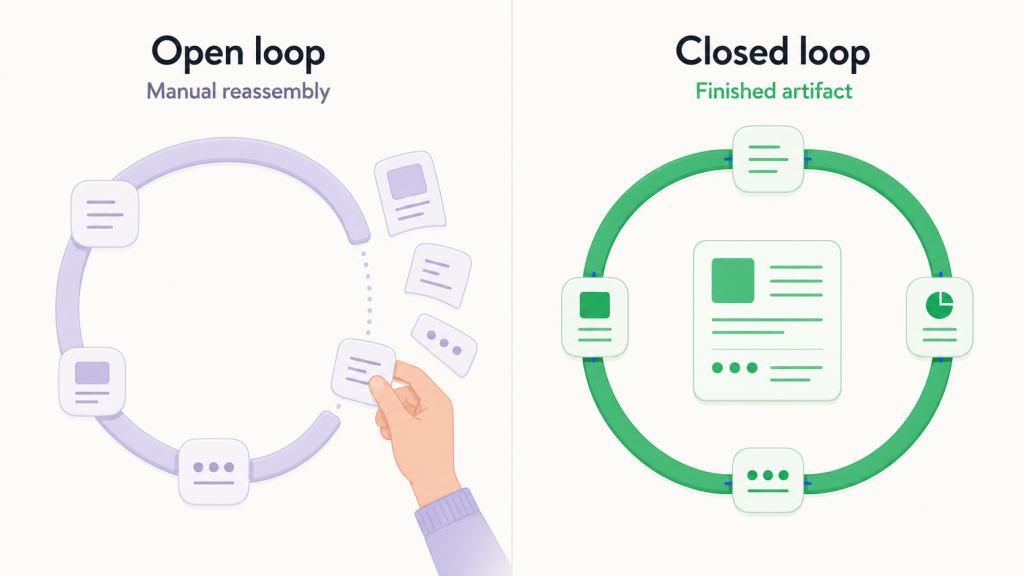
The distinction is easiest to see when you put an open workflow and a closed one next to each other on the same task.
Read down the right column and you have a working definition of AI workflow completion: the artifact is usable the moment the model returns it, and the sensitive values never left the room to make that happen. A closed loop is also a recordable one. Each pass through it can be logged automatically end to end, which is what Article 12 of the EU AI Act expects of high-risk AI systems: events recorded over the system’s lifetime so the results can be traced. Closure is the exception, not the rule: an MIT study reported by Fortune found roughly 95% of enterprise generative AI pilots reach no measurable business impact, most stalling before the work ever finishes. Others scrap the work earlier still: S&P Global Market Intelligence found the average organization abandoned 46% of its AI proofs-of-concept before they reached production.
A quick self-diagnostic
Run your current AI workflow against this short test. If you answer “yes” to more than one of these, you have an open loop, not workflow closure:
- After the model responds, does a person still copy the output into the real document?
- Does the answer come back referring to placeholders like “Party A” instead of real names?
- Does someone reapply the original formatting, tables, or clause numbering by hand?
- Would doubling the document volume roughly double the human hours spent finishing?
- Do the real values get pasted back in a spreadsheet or editor outside any controlled step?
Where workflow closure fits
Workflow closure is the second half of sensitive AI workflow enablement. The first half sends the structure of the work across the boundary and lets the model run in place; closure brings the result home as a usable document. What the workflow delivers at the end is a reconstructed operational artifact, which is the real unit of AI delivery, not a chat transcript. The substitute, execute, and reconstruct mechanism is handled by a Context-Preserving Data Layer for AI, in CUBIG’s case LLM Capsule, which runs on the CUBIG Syntitan platform.
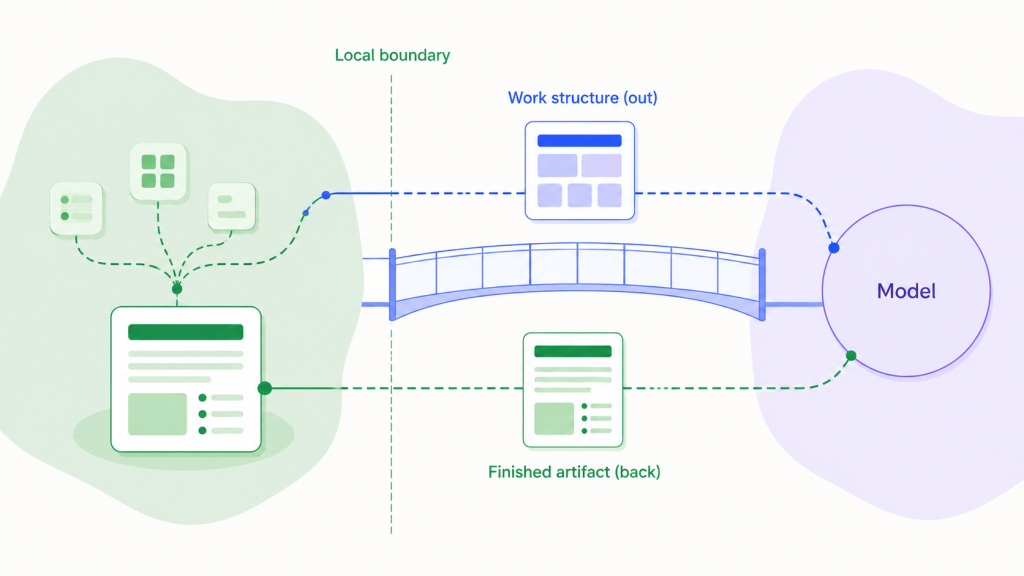
LLM Capsule is what makes closure the default rather than the exception. The work runs end to end on substituted data and the finished result is reconstructed inside your environment, so the workflow actually finishes.