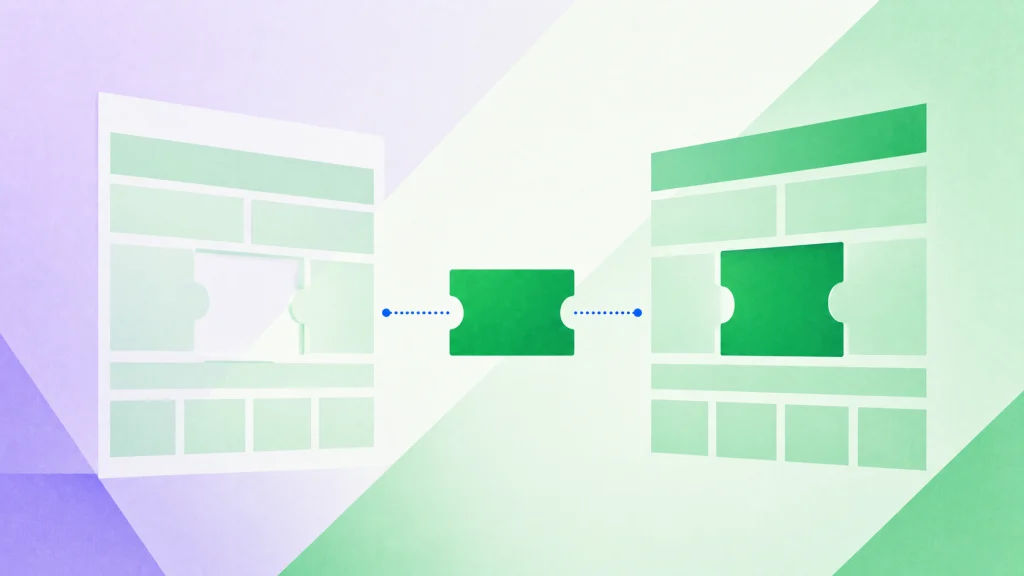
Confidential business context is the sensitive information that has nothing to do with personal data: pricing logic, contract terms, trade secrets, internal metrics, and operational detail that describes how a company competes, and it quietly blocks more enterprise AI projects than personal data ever does.
When people hear “sensitive,” they picture personally identifiable information: names, account numbers, health records. Two decades of privacy law trained everyone to look there. Yet the data that actually stalls an enterprise AI project is usually not personal at all. Samsung’s 2023 episode is the canonical case: the company temporarily banned generative AI on company devices after employees leaked sensitive internal data to ChatGPT, and what leaked was corporate material, not customer records. The pattern holds across enterprises: a Harmonic Security analysis found that customer records, legal and finance material, and security details, not just classic PII, make up most of the sensitive data employees paste into AI tools. And the gap is systemic: Stanford HAI’s 2025 AI Index notes organizations acknowledge these risks while their mitigation efforts lag. Projects like these stall for a reason no privacy tool addresses: the data the model needs is commercially sensitive, and no one can safely hand it over.
What confidential business context actually covers
Walk through one contract and it comes into focus. The counterparty name might sit near personal data. The negotiated discount, the renewal terms, the volume commitments, and the penalty clauses do not. None of that is personal, and every line of it is information the company would never want in a rival’s hands or in a model’s training set. Pricing strategy, margin assumptions, the internal metric that reveals which product line is carrying the quarter: this is the material that decides who wins the deal.
Confidential business context. Sensitive information whose value is commercial rather than personal, where the sensitive part and the useful part are the same part.
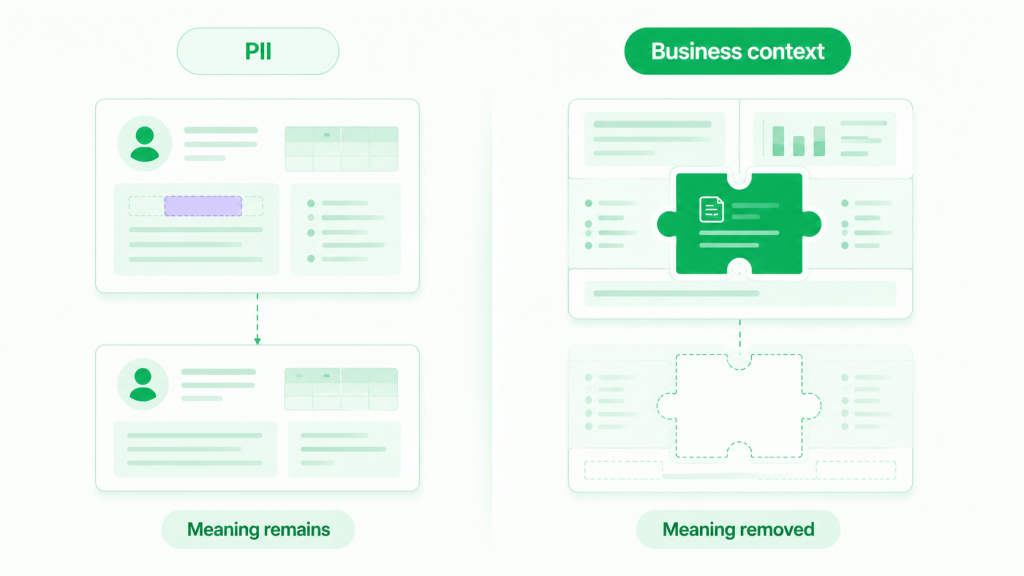
That last property is what makes it different. Redact a customer name and you can still summarize the document. Redact the pricing and the contract logic, and nothing worth summarizing remains. The sensitivity lives inside the exact content that carries the meaning, so removing it does not just create privacy risk, it destroys the task.
Why it blocks AI projects more than PII does
Personal data has a mature playbook. Teams mask it, tokenize it, or drop the column, and legal knows those techniques cold. Confidential business context has no equivalent, because it is not a field you can strip. It is woven through the numbers, the relationships between clauses, and the phrasing of a single term. There is no clean seam between the sensitive part and the useful part, so the usual reflex of removing the sensitive column leaves you with a document a model cannot reason about.
The project then stalls in a familiar spot. A data team wants to run a model across the renewal portfolio. Legal reviews what would leave the building during LLM data egress and declines. The compromise, a version with commercial terms stripped out, produces output too generic to act on. Everyone agrees the AI would help, and nobody can get the data to it. The blocker was never personal data; it was the business context the whole exercise depended on.
How plain masking falls short here
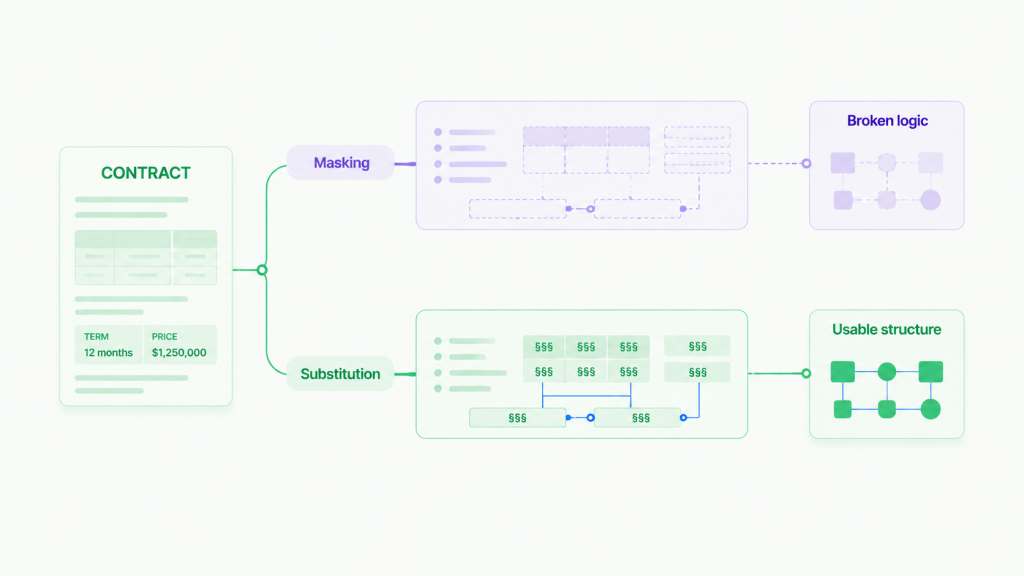
To see why enablement differs from masking, compare what each does to the same confidential contract.
Plain masking treats every sensitive token as noise to be blotted out. That works for a stray Social Security number. It fails on a pricing table, because the model still needs the shape of that table, the way one clause references another, and the fact that a penalty triggers on a specific condition. Blank those out and you have not protected the work, you have removed it.
Operating on it without exposing it
The resolution applies the same enablement pattern that works for personal data to a harder target. You do not have to choose between exposing commercial terms and gutting them. You send the model the structure of the work rather than the raw values: the contract keeps its clauses, its tables, and its internal references, while the real pricing and terms are represented by faithful stand-ins. The model reasons over a coherent document, and the real values are reconstructed locally so the result is usable.
What makes this fit confidential business context specifically is that structure is preserved rather than blanked. A masked contract loses the logic the model relied on. A structure-preserving copy keeps the relationships, so this price maps to that term and this penalty follows that condition, while the literal values stay inside your environment. The model gets a real problem to solve, and the company’s commercial detail never crosses the boundary. Performance you see on a substituted document is representative until you reconstruct and confirm it on your own workflow.
A quick self-diagnostic
Run this test on any AI project that keeps stalling in review:
- If you removed every name and account number, would the remaining data still be too sensitive to send out?
- Does the value the model needs live in pricing, terms, margins, or internal metrics rather than in personal fields?
- When you strip the sensitive parts to get approval, does the output come back too generic to act on?
- Has legal blocked a project even though no personal data was involved?
- Do your current masking tools have no clean way to handle a document where the numbers are the point?
Say yes to two or more, and the blocker is confidential business context, not privacy. That distinction changes which tool you reach for, because a privacy tool is built to remove sensitive values while the work here depends on keeping their structure. Naming the category correctly is the first step toward unblocking the project instead of watering it down.
Where it fits
Treating confidential business context as a first-class category is central to sensitive AI workflow enablement. It explains why the boundary cannot be solved by personal-data tools alone, and why reconstruction matters: the output has to return as a finished operational artifact with the real terms restored, which is how the workflow closes. This is also the step beyond simple redaction that separates enablement from plain PII masking. The substitution and reconstruction run through a Context-Preserving Data Layer for AI, in CUBIG’s case LLM Capsule, which runs on the CUBIG Syntitan platform.
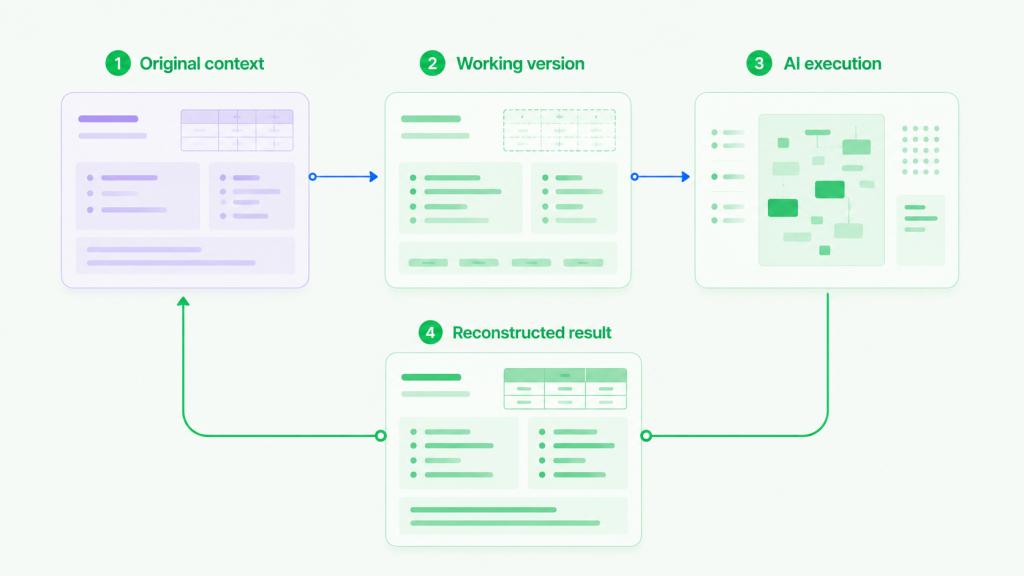
LLM Capsule treats this business context as first-class, not just personal data. Pricing, terms, and internal figures are substituted before the prompt leaves, so the model reasons over the real shape while the values stay inside.