
An operational artifact is the real unit of AI delivery: a finished business document, reconstructed inside your own environment with the real values in place, that a person can send, file, or sign without rebuilding it first. It is not raw model text, and it is not a chat reply someone still has to clean up. It is the thing the work was actually for.
Most conversations about AI output stop at the model’s response, and that framing quietly sets the bar too low. Regulation already refuses that framing: Article 12 of the EU AI Act obliges high-risk AI systems to record events automatically across their entire lifetime, precisely so that results stay traceable after the fact. The cost of stopping short is measurable: S&P Global Market Intelligence found the share of companies abandoning most of their AI initiatives jumped to 42%, up from 17% a year earlier. Deloitte’s enterprise survey points to why: regulatory-compliance concern has become the top barrier to deploying generative AI. When you measure delivery by the answer instead of the finished artifact, the work that turns an answer into a usable document stays invisible until it starts eating the time the AI was supposed to save.
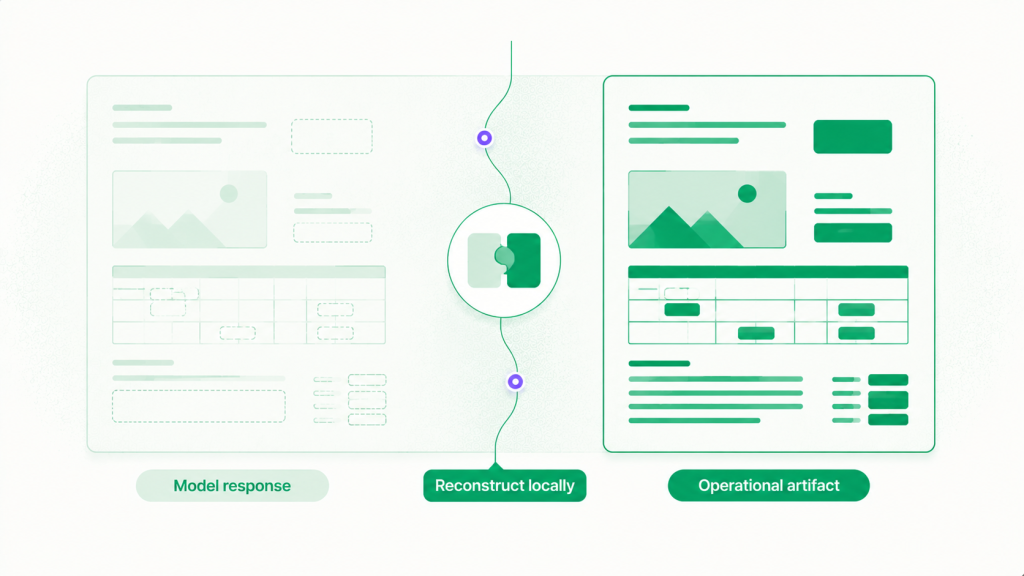
The gap between a response and a result
A model returns text, and often the text is good. But a response is not yet a result. The renewal letter the model drafted still carries placeholder names where the customer’s real details belong. The reconciliation it produced references stand-in figures, because the real numbers never left your systems. Someone on the team then has to take that response and turn it back into the document the business needed.
That last mile of reassembly is invisible in a demo and very visible in production. It is manual, it is easy to get wrong, and it scales badly: every run of the workflow inherits the same cleanup. The demo looked finished; the workflow was not.
Why the gap exists at all
The gap is structural, not a bug in the prompt. When you run AI on confidential data the right way, the model never sees the real values, so it works on substitutes and its output is naturally keyed to those substitutes. A response built on substitutes is honest about what it is; it is simply not done. The model still understands the task because you send it the work’s structure, not the raw values. For why the model works on substitutes in the first place, see confidential business context.
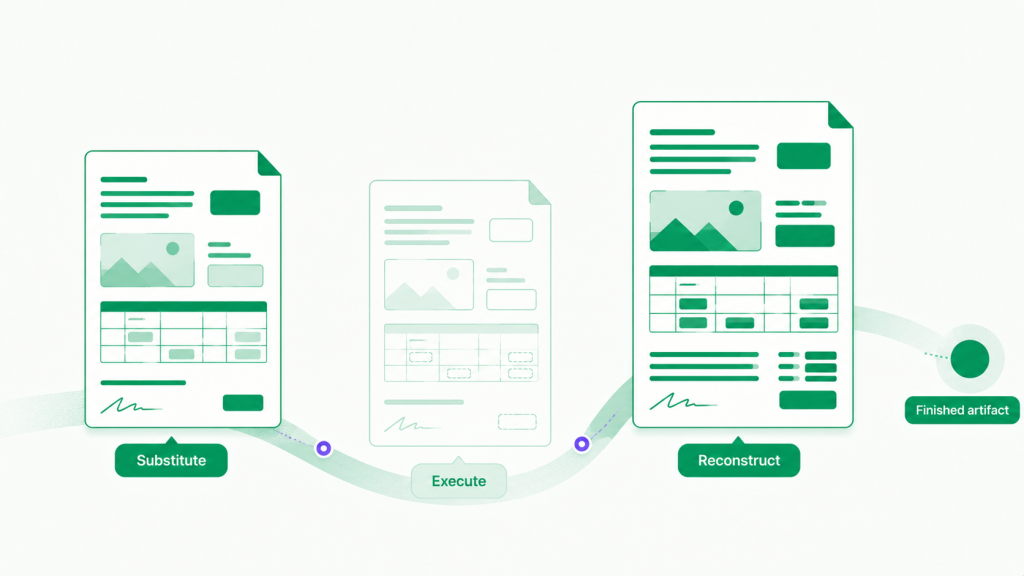
The point of the approach is to substitute, execute, and then reconstruct. The substitution keeps the real data in place. The reconstruction is what closes the distance between a plausible answer and a finished artifact.
What makes an operational artifact operational
An artifact is operational when three conditions hold at once. First, it carries the real values, restored from the substitutes the model worked on. Second, it lands in the format the team already uses: the actual letter, report, or record, not a block of text to reformat. Third, it is complete enough to act on, so the next step is to send it, file it, or sign it rather than rebuild it.
Getting there takes an explicit reconstruction step. The model’s response comes back, and inside your environment the stand-ins are reversed to the real values while the output is reassembled into its proper form. What leaves the boundary is structure; what returns to the user is an operational artifact. That reconstruction is performed by a Context-Preserving Data Layer for AI, in CUBIG’s case LLM Capsule, which runs on the CUBIG Syntitan platform.
Response versus operational artifact
The distinction is easier to hold once you put the two side by side. A response is what the model hands back; an operational artifact is what the workflow is measured on.
| Dimension | Model response | Operational artifact |
|---|---|---|
| Values shown | Substitutes | Real values, restored locally |
| Format | Raw text to reformat | The document the team already uses |
| Next action | Reassemble by hand | Send, file, or sign |
| Where it forms | At the model | Inside your environment |
| What you measure | A good-looking answer | Work that actually closed |
Why naming the unit of AI delivery changes what you measure
Naming the unit changes the definition of success. If the deliverable is “a model response,” success is a good-looking answer, and the reassembly work hides in someone’s afternoon. If the deliverable is an operational artifact, success is a document that closes the task, and you can see immediately whether the workflow actually finished. That is the difference between AI that demos and AI that delivers, and it is what workflow closure is built to deliver.
It also sharpens how you plan enterprise AI adoption. Teams that budget for the artifact, not just the answer, stop being surprised by the hidden cost of the last mile, because they measured for it from the start.
A quick self-diagnostic
Run your current AI workflow through these questions. If you answer “no” to any of them, you are shipping responses, not artifacts.
- When the model finishes, does a real, usable document come out, or does someone still have to reassemble it?
- Does the output already carry the real values, or does it still show placeholders and stand-in figures?
- Is the deliverable in the format the team actually uses, or is it text waiting to be reformatted?
- Can the next person send, file, or sign it, or do they have to rebuild it first?
- Do you track the finished artifact, or only whether the answer looked right?
Where it fits in sensitive AI workflow enablement
The operational artifact is the output side of sensitive AI workflow enablement. Structure crosses the boundary on the way out, as described in LLM data egress, and an operational artifact comes back on the way in, reconstructed locally so the real values never had to travel. All of it runs on the CUBIG Syntitan platform, which lets a regulated team complete confidential work with an AI model without sending the model anything it should not hold.
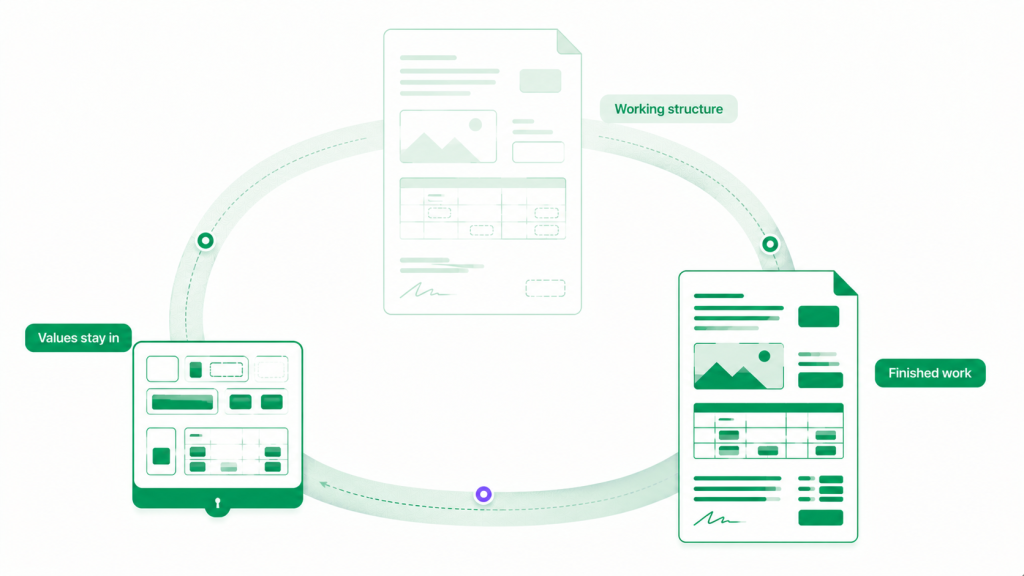
LLM Capsule is what turns model output into an artifact your team can use. The result is reconstructed inside your environment with the real values restored, so what comes back is a finished document rather than a placeholder. That finished document—not the model’s reply—is the real measure of AI delivery.