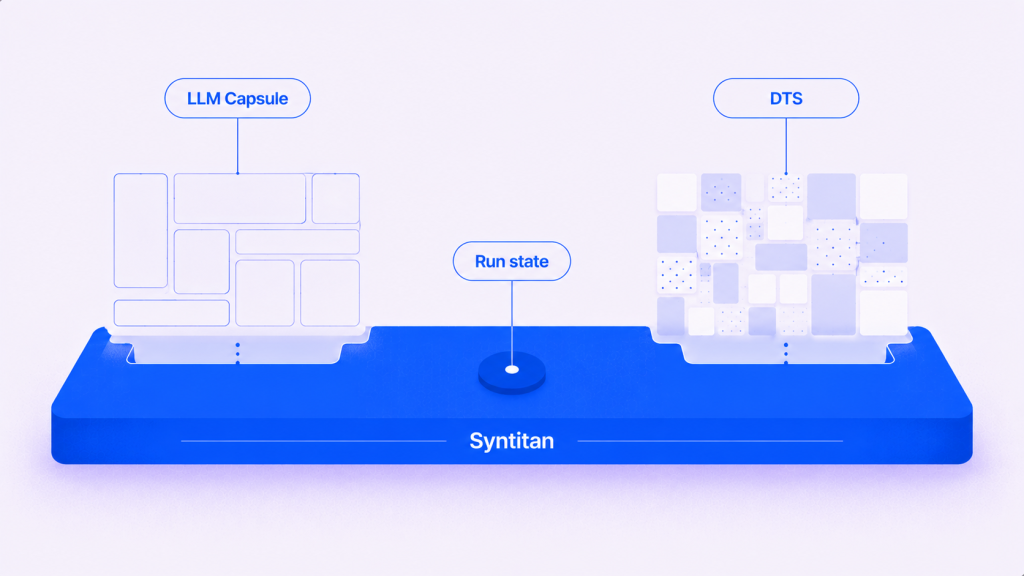
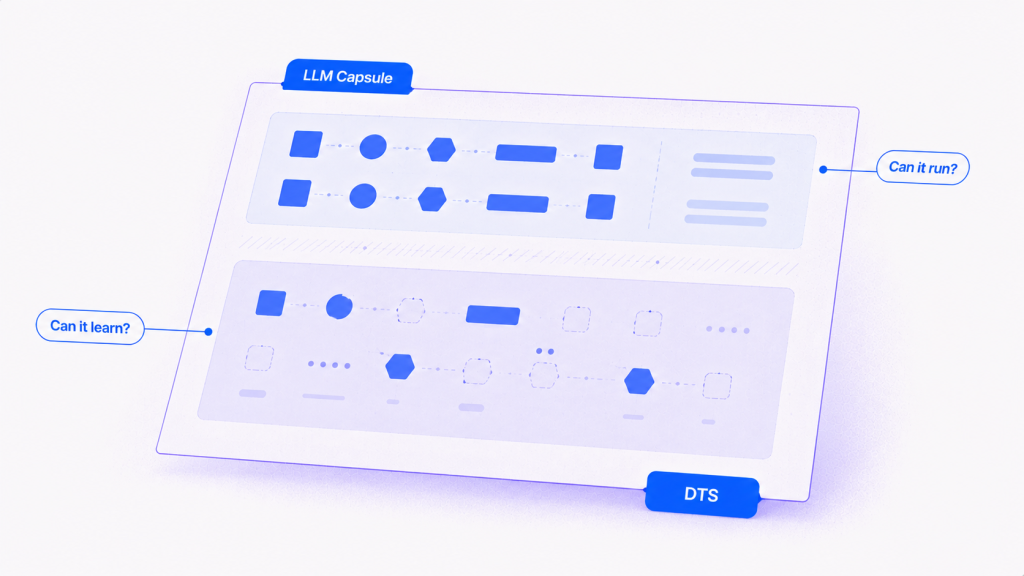
If you came to CUBIG for LLM Capsule, you need DTS only when your data itself cannot teach or answer the model, not when your worry is sending confidential data to an LLM; LLM Capsule solves the second problem, DTS solves the first.
Most teams arrive with a concrete blocker: legal will not let a model see raw customer records, so an AI project that looked ready in a demo stalls the moment it touches production data. That is the LLM data privacy question, and it is what LLM Capsule answers. The DTS question is quieter and shows up later, when the data you are allowed to use turns out to be too thin, too skewed, or too locked-down to train or evaluate anything reliable. The first blocker is well grounded, because anonymized records can often be linked back to individuals once enough attributes are combined. In practice those two failure modes, no access and no usable data, are behind many stalled AI projects. Knowing which one you actually have keeps you from buying the wrong tool.
LLM data privacy: what LLM Capsule does, and where it stops
LLM Capsule lets AI work with operational data that can’t be sent as raw data, using context-preserving substitution. The model receives the structure of the work, not the raw sensitive values. The pattern is Substitute, Execute, Reconstruct: sensitive values are replaced with context-preserving stand-ins inside your environment, only the substituted working version goes to the approved model, and the response is checked and connected back to the real business values through an internal mapping that stays on your side.
That closes a specific LLM data privacy gap. Your analysts can run a frontier model over contracts, tickets, or patient notes without the underlying values crossing the LLM data egress line. The work completes in place, and you keep an operational artifact you can hand to an auditor.
Here is the boundary of what it does. LLM Capsule assumes the data you hold is already good enough for the model to do the job once it can see the structure. It does not improve the data. If your records are too sparse to represent the case you care about, or a whole category of examples is legally off-limits, protecting them on the way to the model changes nothing, because the model still has too little to work with.
What DTS does that a data boundary cannot
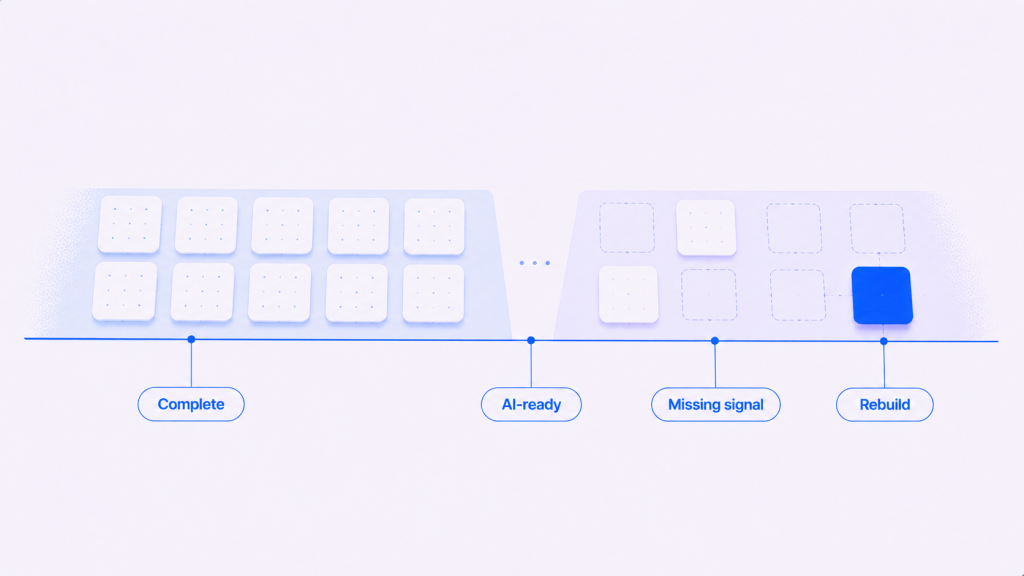
DTS is CUBIG’s data preparation engine: it turns locked, scarce or regulated data into AI-ready data for training, testing, evaluation and sharing. Where LLM Capsule handles how AI works with data that can’t be sent as raw data, DTS works on the data itself. It diagnoses what makes a dataset unusable, then synthesizes the cases and conditions the task needs, including rare patterns that barely appear in your real records. The output is a set of data candidates rather than a replacement for real facts, and its effect is checked under the same task, model and evaluation conditions. It uses a non-access architecture, and differential privacy is available as a technique when the source is restricted. That technique deserves care in its own right: NIST SP 800-226 provides guidelines for evaluating differential privacy guarantees and documents the common implementation pitfalls it calls privacy hazards.
The tell is simple. If your problem is that the data exists and is fine but must stay confidential, DTS is not your answer. If your problem is that the data you are allowed to touch cannot support training or evaluation, no boundary product will fix that, and DTS is the CUBIG product built for that problem.
LLM Capsule vs DTS: which blocker are you solving?
The two products answer different questions. One is about access, the other about substance. This table lays them side by side so you can place your own situation.
| LLM Capsule | DTS | |
|---|---|---|
| The blocker it solves | Access: you cannot send the raw data to the model. | Substance: the data itself cannot teach or answer the model. |
| Your situation | The data already exists and is accurate, but must stay confidential. | The data you are allowed to use is too thin, too skewed, or too locked-down. |
| What it does to the data | Lets AI work on a substituted working version; it does not improve the data. | Synthesizes the cases and conditions a model needs to learn from. |
| How it works | Substitute, Execute, Reconstruct. | Diagnose the data, then synthesize what the task needs. |
| Where the data sits | Original values stay inside your environment; the internal mapping stays on your side. | Non-access architecture, with differential privacy available when the source is restricted. |
| Product type | Context-Preserving Data Layer for AI. | Data preparation engine, available as an independent product. |
When you came for LLM Capsule but actually need both
Plenty of teams need both, and the order depends on which blocker shows up first. A bank that wants a model to read confidential deal memos starts with LLM Capsule, because the immediate blocker is egress. Months later the same bank tries to train a fraud model and finds it has only a few dozen real fraud cases, far too few to learn a reliable pattern. That is a DTS problem, and no amount of boundary protection creates the missing examples.
The reverse also happens. A team adopts DTS to augment a rare clinical cohort, gets a workable dataset, then wants to run a frontier LLM over the real patient notes for a separate task. Now the access question returns, and LLM Capsule handles it. Treat the two as answers to two independent questions rather than as competitors, and the sequencing takes care of itself.
There is a third thread worth naming, because production teams hit it fast. Once a model runs on synthesized or substituted data, the question is not only which model ran but which data state and execution conditions produced the result. Syntitan, CUBIG’s AI-ready data platform, prepares and checks enterprise data for a specific AI task: it diagnoses the data on six axes (Usability, Integrity, Context, Consistency, Reproducibility, Traceability), applies, holds or excludes the proposed treatments, and creates a new data Version after each successful processing run, so you can see which data was used at the time. Tracking and reusing data after later changes is planned for December.
A quick self-test before you choose
Run through these. If most of your yes answers land in the first cluster, you came to the right place for LLM Capsule. If they land in the second, you are looking at a DTS problem instead.
- The data I need already exists and is accurate, but compliance will not let it reach the model. (LLM Capsule)
- My analysts want to use a frontier LLM on confidential records without those records leaving our boundary. (LLM Capsule)
- The case I most need to detect barely appears in my real data. (DTS)
- A whole category of records is legally off-limits for training, so my model never sees it. (DTS)
- My evaluation set is too small or too skewed to trust the numbers it produces. (DTS)
- I need both: run a model on confidential data now, and prepare data for a scarce case in a separate task later. (Both)
Where it fits in CUBIG’s operating layer
LLM Capsule, DTS and Syntitan are entry points into the same AI-ready data operating layer for enterprise AI execution. LLM Capsule lets AI work with operational data that can’t be sent as raw data; DTS synthesizes data for cases your real records cannot cover; Syntitan prepares and checks data for a specific AI task and keeps each result as a Version. You do not have to decide the whole architecture on day one. You do have to name the blocker in front of you correctly, because the right first product follows directly from that.
If you are still unsure which side of the line you are on, the fastest way to find out is to look at the data you would hand the model tomorrow and ask whether the problem is that you cannot send it or that it cannot answer. For the deeper split between synthesizing data and working with protected data, our guide on whether synthetic data buyers actually need LLM Capsule takes the same decision from the other direction, and what DTS is covers the engine in full.
Try it on your data for free. Run a sample proof and see it on your own workflow.